-
Why I started paying attention to what's in your hand
-
Cheap mechanical pencils: a $12 mistake that cost me a week of goodwill
-
When the printer goes offline at the worst possible time
-
Specialist calculators: the $9 mistake that cost me credibility
-
The objection I always hear: 'It's just a pen'
-
What I do now
Let me state the position up front: cheap office supplies are the most expensive thing your company will ever buy. I didn't always believe that. In fact, for my first two years as the person responsible for ordering office supplies, I treated pens, calculators, and printer cartridges as interchangeable commodities. Whatever was cheapest, I bought it. I am embarrassed to admit how long it took me to realize I was costing us more than I was saving.
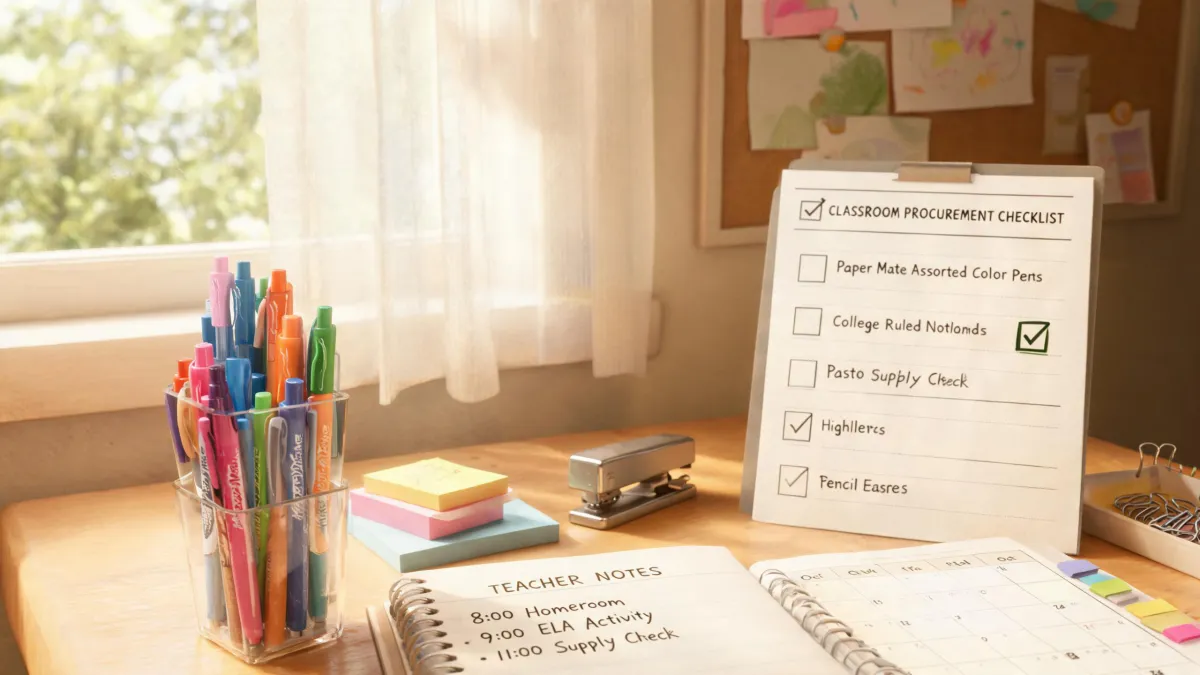
I'm the operations manager at a mid-sized engineering firm. Since 2020, I've handled every office supply order that comes through our door. In that time, I've personally made enough mistakes to fill a checklist—and I've written one so nobody else repeats them.
Why I started paying attention to what's in your hand
In early 2022—no, it was April 2022, because we had just come back from a trade show—we hosted a potential client for a contract walkthrough. This was a big deal, a $120,000 deal, potentially our biggest of the year. At the end of the meeting, we needed them to sign. I handed them a pen from our visitor mug. It was a cheap ballpoint I'd ordered in bulk, 100 for about $45.
The pen skipped twice. Then it stopped making marks entirely.
The client turned it over, looked at the tip, tried again, and grinned awkwardly. I quickly swapped it for another one. That one was better—it wrote about two words before the ink went patchy. I don't remember what the client said. I just remember the silence as they signed the last two lines with my own backup pen, the one I keep in my shirt pocket.
That was the moment I started comparing pens side by side. When I put our budget ballpoints next to a Paper Mate Flair felt pen, I finally understood what all the fuss was about. The Flair laid down a crisp, even line. No skipping. No scratching. The cheap pen looked like it was gasping for breath.
I don't have hard data on how many deals are lost because of a bad pen. What I can say anecdotally is that we stopped putting budget pens in the meeting room after that client visit, and nobody ever mentioned a pen problem again.
Cheap mechanical pencils: a $12 mistake that cost me a week of goodwill
Our engineers go through mechanical pencils like coffee filters. When I took over procurement, I noticed we were paying about $2 each for Paper Mate mechanical pencils. The Clearpoint series, if you want the exact model.
I thought that was wasteful.
So I ordered a different brand. The price was about $0.80 per pencil, and we were buying 60 of them. I saved roughly $72 that month—actually, it was closer to $80, because that brand had a rebate. The engineers hated them. The clips snapped off. The lead advanced erratically. One person told me they'd rather bring their own from home than borrow another one of "those things."
I didn't want to admit I was wrong, so I kept pushing. Over the next month, I counted eleven broken pencils tossed in the trash—that I found. I had spent $48 on 60 pencils, and we went through them in three weeks. It's hard to measure the time cost of annoyed engineers, but I know at least one of them bought his own box of Clearpoint pencils and kept them locked in his desk.
That was my lesson in something that should have been obvious: the cost of a tool is not the price on the receipt. It's the performance per dollar.
When the printer goes offline at the worst possible time
Then there was the printer. Our main office printer, a workhorse machine, started refusing to cooperate about six months after I switched its cartridges to a cheaper third-party brand. I saved maybe $40 per cartridge, give or take. I was proud of myself.
Then the machine started dropping offline. At first it was once a week. Then daily. Then it happened at 9:30 on the morning of a scheduled board meeting.
I knew the board materials were in the print queue. I also knew the printer didn't want to talk to the network. If you've ever typed how to get printer back online into a search bar while your executive team waits for a report, you already know the feeling: it's not a single fix. It's a rabbit hole of driver updates, network settings, and "restart the print spooler" suggestions that only work if you're lucky.
I managed to get it back online at 10:14 AM. The meeting started at 10:30. I got the documents onto the table with eight minutes to spare. The printer went offline again eleven minutes later.
The deeper problem was quality. When we printed a client's branded materials using that cheap toner, the company blue came out looking purple. If you know anything about color standards, a brand color with a Delta E above 4 is visible to most people. Pantone's matching system uses Delta E less than 2 for brand-critical colors. Our "bargain" toner was way beyond that. The client didn't say anything directly, but our account manager said they mentioned the colors looked "a little off."
Of course they did.
After that, I switched back to manufacturer cartridges and took the time to update the printer's drivers properly. The printer hasn't gone offline since. That's not a perfect scientific statement—it's just what happened. When you stop fighting the machine with half-compatible parts, it works like it's supposed to.
Specialist calculators: the $9 mistake that cost me credibility
One part of procurement I didn't expect: engineers requesting very specific calculators. A new hire asked me to order an rref calculator for a project. I had no idea what it was. I didn't ask. I bought a $9 calculator from the nearest office supply order, thinking "calculator is a calculator."
When it arrived, he came to my desk and held it up. "This is a basic four-function calculator," he said. "I asked for an rref calculator—reduced row echelon form. I need to do linear algebra on this."
I didn't even know that was a thing. But the look on his face told me everything: he couldn't do his job with the tool I'd chosen for him. And more importantly, he'd lost confidence in my judgment.
The same week, another engineer requested a crcl calculator. I froze. Then I decided to ask what it was this time. It wasn't a special brand—it was a circular calculation tool for a specific structural calculation. I found a proper one, and it cost maybe $35. The engineer thanked me so sincerely that I felt guilty for almost doing the same thing again.
I have mixed feelings about that whole episode. On one hand, I was trying to keep costs down, which is part of my job. On the other hand, I was so focused on the price tag that I forgot the point of buying anything at work: helping people do their work well. The $9 I "saved" on the wrong calculator cost me two engineers' trust, a round trip to the shipping return, and more time than I want to admit. At least, that's been my experience with the math-heavy crowd.
The objection I always hear: 'It's just a pen'
I know what some people are thinking: A pen is a pen. If it writes, it works. I used to think that too. That's where the trap lies.
A pen isn't just a pen. It's the first thing a client touches when they walk into your office. It's the tool your team reaches for when they need to write down a promise. When it feels cheap, it makes the whole company feel cheap. Same for a printer that can't stay online, and a calculator that can't calculate what the job requires.
I'm not saying every purchase has to be the premium option. That would be ridiculous. But I am saying that saving money in the wrong place is an expensive way to save money. The extra twenty or forty cents it takes to put a decent Paper Mate pen in someone's hand is nothing compared to the awkwardness of watching a client try to finish a signature with a pen that decided to quit.
Quality is a visible signal. It tells people you pay attention to details. It tells your employees you care about the tools they use. And it tells clients that your company doesn't cut corners on the things that matter.
What I do now
I've now spent the last two years using a simple rule: default to brands with a track record, and only downgrade when I'm sure the cheap option won't hurt. For writing instruments, that means Paper Mate felt pens (the Flair series) in the meeting rooms and Paper Mate mechanical pencils (Clearpoint) for our engineers. For calculators, I ask before I buy. For the printer, I use the right drivers and the right cartridges, and I budget for them.
This isn't about being fancy. It's about being dependable. I've watched our client feedback on meeting logistics go from "good" to "noticeably professional," and I can't prove it's because of the pens, but I've compared enough bad pens and good pens side by side to know it isn't hurting anything.
I wish I'd learned this sooner. I don't have a spreadsheet that directly links pen quality to contract wins. But I know what it felt like to hand someone a bad tool and watch their impression of us change. That's the kind of cost that doesn't show up on a purchase order. It just shows up in the way people talk about you after they leave.
Cheap supplies are expensive. Every time. That's the opinion I've earned—through my own mistakes, my own budget, and my own reputation.