-
Opinion: Most Office Emergencies Are Self-Inflicted, and I Can Prove It
-
Argument 1: "The Pen Ran Out" Is Not a Legitimate Emergency (But It Keeps Happening Anyway)
-
Argument 2: Estimating Instead of Calculating Is the Most Expensive Habit in Any Workspace
-
Argument 3: The Mess You Handle in Five Minutes Costs $50. The One You Handle Tomorrow Costs $500.
-
"But Isn't This Overkill?" (The Counterargument I Hear Most Often)
-
Bottom Line
Opinion: Most Office Emergencies Are Self-Inflicted, and I Can Prove It
I coordinate rush orders for a living. In the past three years I've handled somewhere north of 200 emergency requests — the kind where someone calls at 4:47 PM and needs something "by 9 AM or we lose the account." And after all of that, here's the uncomfortable truth I've come to accept: maybe 15 of those emergencies were genuinely unavoidable. The other 185? They were preventable. Every single one.
What I mean is that the emergencies that really hurt — the ones with penalty clauses and angry phone calls and people working through the weekend — almost always trace back to a moment weeks earlier when someone could have checked something and didn't. A supply that ran dry. A quantity that was estimated instead of calculated. A spill that sat for an hour before anyone Googled what to do about it.
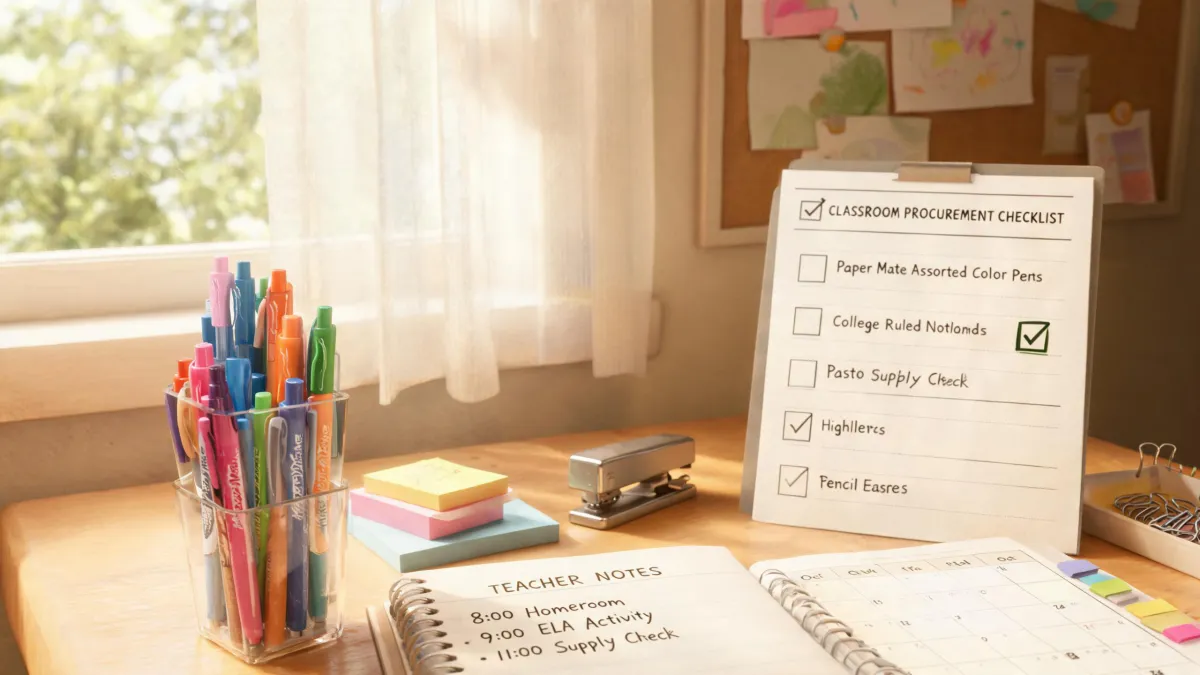
So I've made a small, slightly obsessive habit of keeping three things within arm's reach at all times: a reliable set of pens and pencils (I'll explain which ones in a second), a calculator for volume conversions, and a stain-removal cheat sheet. None of it is glamorous. All of it has saved me from becoming the person on the other end of the 4:47 PM phone call.
Argument 1: "The Pen Ran Out" Is Not a Legitimate Emergency (But It Keeps Happening Anyway)
I know how this sounds. A pen running out of ink is the least dramatic problem imaginable. But put that pen in the hand of someone signing a contract, or annotating a print proof, or filling out the one form that has to be handwritten — and suddenly a $2 problem becomes a $200 problem because someone has to run to the store around the corner (which, of course, is closed).
This is where I'll get specific, because vague advice annoys me. The Pentel EnerGel XM capped pen has become my default for exactly this reason. It's a capped liquid gel pen, which sounds like marketing language until you've watched a retractable pen leak in a bag and destroy an entire stack of printed materials. The cap means no accidental clicking, no ink transfer, no ruined documents. The 0.5mm and 0.7mm versions write consistently enough that I've stopped keeping "backup" pens in my desk — I just keep a backup cartridge, which costs less than a coffee and takes four seconds to swap.
And for anything involving dimensions, markups, or sketches that someone will later need to read, the Pentel 0.3 mm mechanical pencil does something that sounds trivial but isn't: the lead doesn't snap under normal pressure. I've tested this the way anyone actually tests it — by writing and sketching with it for months instead of carefully observing it in a lab. I've had cheaper 0.3 mm pencils where a single heavy line meant re-loading lead. The Pentel GraphGear 1000 (which is what I use) has a sliding sleeve that protects the lead tip. If you've ever tried to fill out a form with a broken lead tip, you understand why this matters more than the price difference.
Here's the part I can't prove: I'm honestly not sure why some offices still buy 40-cent bulk pens and then act surprised when half of them fail within a month. My best guess is that it's a procurement-habit thing — someone set up the supply order years ago and nobody's touched it since. But I've done the math on what a mid-tier pen costs per year versus what one "pen failure" meeting actually costs in wasted time, and the numbers aren't close.
Argument 2: Estimating Instead of Calculating Is the Most Expensive Habit in Any Workspace
This one is less obvious, so bear with me.
If you've ever ordered materials for a project and come up short — lumber, fabric, packing filler, whatever — you've experienced the cost of estimating instead of calculating. It's one of those problems that feels small until you need 12 more units and the supplier has a 5-day lead time and your deadline was yesterday.
Two tools have quietly prevented more of these situations than any project management software I've used: a board foot calculator and a cubic feet calculator. The board foot calculator is specifically for lumber — one board foot equals 144 cubic inches, and if you're ordering wood (as many offices and studios do for fixtures, signage, and packaging prototypes), getting this number wrong is how you end up making two trips. The cubic feet calculator handles volume — how much a box holds, how much filler you need, how much storage a stack of materials actually takes up.
Why am I mentioning these in an article about office emergencies? Because "we didn't order enough" is a top-three cause of rush orders. It's not dramatic. There's no villain. Just a person who looked at a pile of materials and guessed. The calculator removes the guess.
The seductive-but-wrong version of this advice is "always measure twice." Sure. But measuring twice doesn't help if you're measuring the wrong thing — if you're computing linear feet when the vendor prices in board feet, or cubic inches when the shipping quote assumes cubic feet. The tool doesn't just save time. It forces you to ask the right question before you act.
Argument 3: The Mess You Handle in Five Minutes Costs $50. The One You Handle Tomorrow Costs $500.
Here's the counterintuitive part about how to get acrylic paint out of clothes: the answer isn't complicated. Acrylic paint is water-soluble when wet and effectively plastic when dry. If you catch it while it's wet, you blot it (don't rub — rubbing pushes pigment into fibers), rinse from the back of the fabric with cold water, and apply a small amount of dish soap or rubbing alcohol depending on the fabric. That's it. Maybe five minutes of work.
If you wait until it dries? Now you're scraping with a dull knife, applying heat or solvents that may damage the fabric, and probably going through a cycle or two of "almost got it." You've lost an hour, possibly a piece of clothing, and — if it's a customer-facing item like a uniform or branded sample — a chunk of credibility.
The pattern is identical to the pen-and-calculator points above, which is why I'm grouping them: the cost of the problem isn't the problem. The cost of when you address it is. A five-minute response beats a five-day clean-up. A quick check beats a rush order. A $15 pen beats a $200 scramble.
"But Isn't This Overkill?" (The Counterargument I Hear Most Often)
Yes, I've heard this. Someone — usually someone who has never handled a rush order — will point out that keeping a stain cheat sheet and a board foot calculator in your desk is a little obsessive. And I'll grant the point: it is a bit much for a person who rarely deals with materials or messes.
But here's my rebuttal: the cost of being prepared is nearly zero. A box of reliable pens costs less than $15 (based on publicly listed prices at major stationery retailers, January 2025; verify current pricing). Online board foot and cubic feet calculators are free. The acrylic paint removal instructions are a single web search away. Nothing on this list requires a procurement request, a committee, or a budget line item.
Compare that to the alternative. I've personally seen a rush reprint cost a client an extra $340 because someone's pen skipped on a signature line and the document had to be re-signed and re-scanned. I've watched a team pay 40% more for materials because they came up short and had to source locally. And I've seen a designer nearly lose a client because a paint spill on a sample wasn't handled fast enough (they saved it, barely, after some improvised chemistry that I would not recommend).
The "check first" approach doesn't eliminate every emergency. I still handle maybe a dozen genuinely unpredictable situations per quarter. But the other 90%? Those don't happen anymore. And the mental overhead of "just checking" is so much lower than the mental overhead of "fixing it under pressure."
Bottom Line
I'm not going to pretend that my $15 pen-and-calculator habit is the same as a formal quality control system. It isn't. If you're running an operation with real stakes, you need actual checklists, actual sign-offs, and actual procedures. This was accurate as of January 2025, and the tools I've mentioned haven't changed much in years — but the broader point about prevention economy applies regardless of whatever fancy software you're using.
The point is simpler than that: the cheapest emergency is the one you never have. Check your pen. Calculate the volume. Clean the spill while it's wet. Five minutes now beats five days later. That's not a slogan — it's arithmetic.