-
What is Nasco Education, and where's the actual official website?
-
How do I find a Nasco discount code that actually works?
-
Do science departments actually need specialty calculators — say, an eigenvector calculator?
-
What about creatinine clearance calculators — are those still relevant for lab prep?
-
How do I get acrylic paint out of carpet after an art class disaster?
-
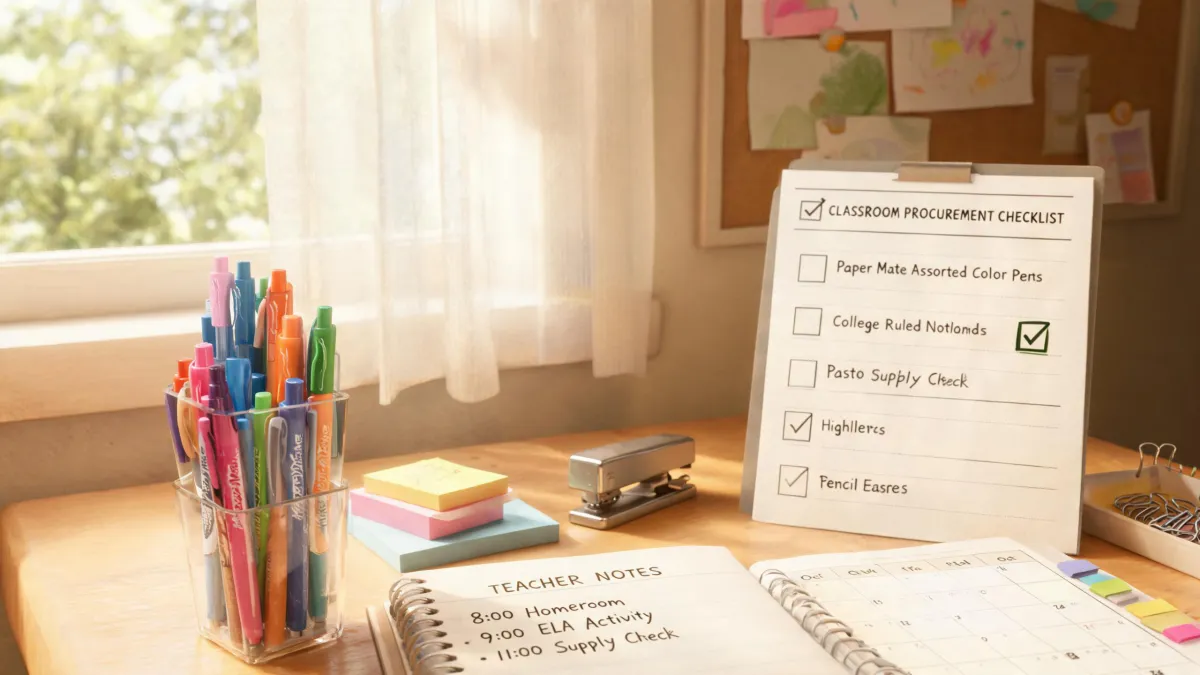
What's the pre-order checklist I actually use now?
-
When's the best time of year to order from Nasco?
I've been handling education supply orders for seven years. In that time I've made — and documented — nine costly mistakes. Roughly $5,200 worth of wasted budget across art, science, and office purchases. This FAQ is what I wish someone had handed me in 2018.
What is Nasco Education, and where's the actual official website?
Nasco is a one-stop education supplier covering science lab materials, art supplies, office equipment, and (yes) calculators. Their main site is nasco.com; the education-focused section lives at nascoeducation.com. Both are legitimate.
But here's the part nobody warns you about. In 2021 I nearly placed a $2,100 first-quarter order through a spoof domain — sitting at position three on Google, with an eerily similar layout. What gave it away was the banner promising "40% off everything." Real Nasco promotions almost never run like that.
Dodged a bullet when I called the ordering line to confirm. Was maybe 20 minutes from submitting a PO to a fake site. So glad I double-checked the domain — that would have been a very awkward call with our business office.
How do I find a Nasco discount code that actually works?
This is where I lost $420 in the fall of 2022. I'd built a cart around a "NASCO-EDU15" code from a coupon aggregator site. Cart said $2,800; code applied; total dropped to $2,380. Looked fine. I approved it.
Then the invoice came through. The code had been expired for six weeks, the price reverted, and I'd already submitted the budget. That was a $420 hole I had to explain in a quarterly review (unfortunately).
What I do now: verify promo codes through my Nasco rep or the official "Current Promotions" page before I place an order — not after. Per FTC advertising guidance (ftc.gov), promotional terms including expiration dates must be disclosed clearly. If a coupon site hides the fine print, assume there's fine print you don't want to see.
Do science departments actually need specialty calculators — say, an eigenvector calculator?
Short answer: depends on the curriculum. Longer answer, from someone who's bought three.
An eigenvector calculator (in plain terms: a matrix calculator that finds the direction vectors a transformation doesn't rotate) is genuinely useful for linear algebra electives. If your math department runs AP math prep or vector-space units, one or two units are worth buying as demonstration tools.
But this is where I messed up in 2019. I bought 30 of them for a general algebra classroom. That was $1,700 I did not need to spend. We ended up using 4. My rule since: buy 1–2 for the department head to pilot before committing to a full classroom set. At least, that's been my experience with K-12 math rooms — your curriculum may differ.
What about creatinine clearance calculators — are those still relevant for lab prep?
Honestly, I'm not 100% sure why our health science instructor wanted a dedicated creatinine clearance calculator (i.e., the formula tool that estimates kidney filtration rate) instead of a general clinical calculator app. My best guess is the simulation lab doesn't allow phones.
If your program runs simulation-based nursing or pre-med training, ask the instructor before ordering. We bought a set of 12 in 2023 for a lab that got canceled by spring. That's $310 in inventory that sat in a closet until we finally donated it to a community college. If you ask me, that's the kind of purchase that should always get a second signature.
How do I get acrylic paint out of carpet after an art class disaster?
Honest answer: act within the first few minutes, or accept that the carpet is now abstract art.
In September 2022, a student knocked over a full quart of acrylic paint onto our library-adjacent carpet. The art teacher blotted with paper towels (fine, but too slow), then tried hot water (worse — heat sets acrylic permanently). By the time the custodian arrived, the stain was 18 square inches and into the top pile.
What I now write on the art room bulletin board:
- Blot — don't rub — immediately with a dry cloth. Acrylic cures as it dries; every second counts.
- Scrape the excess with a plastic spoon or putty knife. Don't dig.
- Use cool water and a dab of dish soap. Warm water accelerates curing (this was my teacher's first error).
- A 1:1 white vinegar and cool water mix cuts through most pigment better than soap alone.
- For dried acrylic, 70% isopropyl alcohol can soften it — but test on an inconspicuous spot first, because it can fade carpet dye.
That incident cost the district $890 in carpet replacement. It's the error that taught me one thing: for K-8 classrooms, stock acrylic in squeeze bottles only. Never open cups. I should add that this single policy change has prevented (as far as we know) two future spills.
What's the pre-order checklist I actually use now?
Seven columns in a spreadsheet. Not fancy — just consistent.
- SKU matches the catalog PDF. We've caught 47 SKU mismatches using this column in the past 18 months.
- Quantity vs. last year's actual usage — not just "what the department head asked for."
- Promo code verified through official channels — never a third-party aggregator.
- Delivery date checked against the school calendar (picture day, testing week, holidays).
- Return policy re-read for anything above $500.
- Color swatch documented for anything brand-critical. If a school color is being printed, check against a Pantone bridge guide before submitting — Delta E of 2 or less is the usual tolerance; above 4 is visible to most people (per Pantone Matching System guidelines).
- Budget owner signed off — in writing.
I should add that #7 didn't exist until 2023, and I regret every order placed before it. To be fair, the SKU column catches the most issues — though I should note we only log 3–4 SKUs per order, so it's a small sample size, not a scientific proof.
When's the best time of year to order from Nasco?
This was accurate as of early 2025. Nasco typically runs back-to-school promotions in July and August. If you order before the September rush, our turnaround was about 4–6 business days and inventory selection was wider.
I want to say their spring clearance runs around late February to mid-March, but don't quote me on that — the timing shifts year to year. I learned this the slow way after missing the window by about a week three years running.
One more thing worth checking: if your order includes anything with a recycled-content or "eco" claim, verify the certification. Per FTC Green Guides (16 CFR Part 260), recyclable claims must be substantiated — a product labeled "recyclable" should be recyclable where at least 60% of consumers have access. Rural districts sometimes don't hit that threshold, which is a compliance headache worth catching before you print the PO.