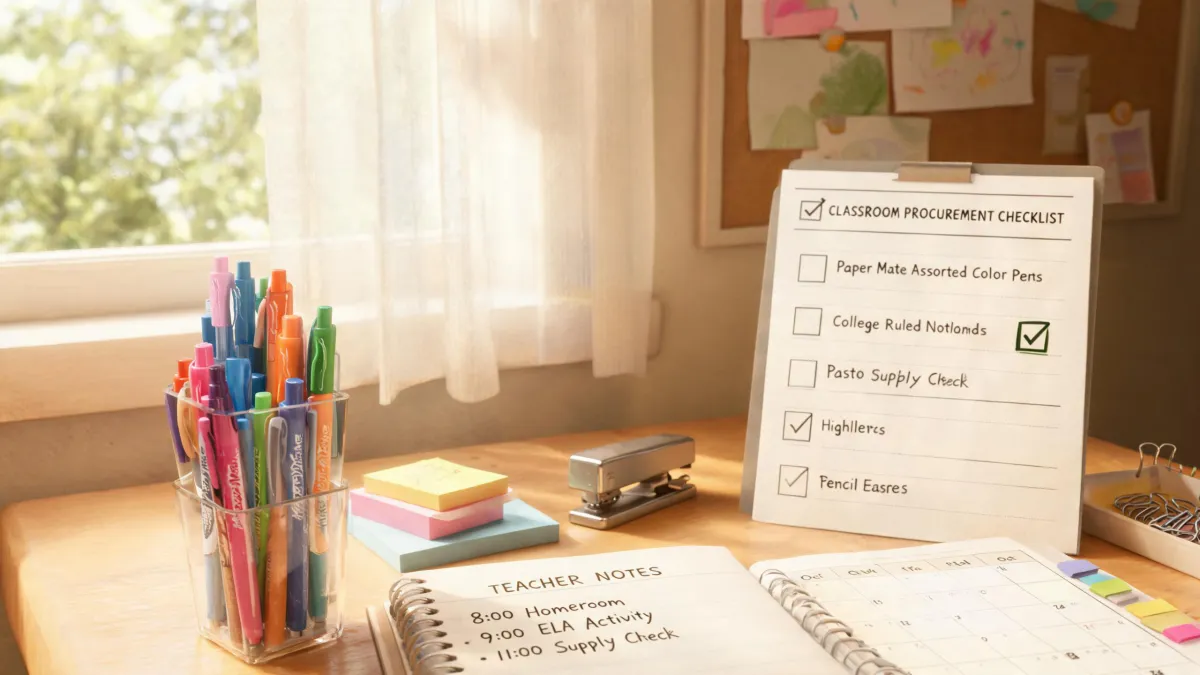
I'm a procurement manager at a 210-person logistics company. I've managed our office consumables budget for 7 years, negotiated with over 40 vendors, and documented every order in our cost tracking system. Here's the phrase that has never been false in my notebook: the lowest unit price is usually the most expensive answer.
In Q3 2024, we bought a $4.29 pack of permanent markers. Two weeks later, one of our team members was standing over a break room sink with a white shirt, typing 'how to get permanent marker out of clothes' into her phone. That stain cost us a $42 dry-cleaning bill, a $26 replacement shirt, and about 45 minutes of three people debating whether nail polish remover would ruin the fabric. The marker cost maybe 18 cents. The interruption cost more than the entire box.
That's the surface problem: office-supply budgets get eaten by small consumables. The usual response is to squeeze unit prices. We switch to a cheaper generic pen, a thinner marker, a lower-priced ink cartridge. Then the overruns come back. Why? Because the problem was never the unit price.
The Obvious Problem: Overruns in the Consumables Line
Every year, I look through our procurement system and see the same pattern. Paper orders are up. Printer ink orders are up. A box of pens disappears faster than expected, so someone submits a rush request. At first glance, this belongs in the purchasing category. It doesn't. It belongs in the decision and behavior category. But as long as the process starts with 'find the cheapest SKU,' that truth stays hidden.
To be fair, the cheap markers did what they were supposed to do: they marked things. They also marked a shirt, a clipboard, and a skin-colored forearm. The marker purchase was easy. The cost of that purchase kept showing up in odd places.
The Deeper Cause: We Buy Products, Not Outcomes
It's tempting to think you can just compare unit prices. But identical-looking products from different vendors can produce wildly different outcomes. A 'good deal' on a photo printer can disappear when ink yields are low, print heads clog, or the driver doesn't work on your OS. What I mean is that the true cost of any supply item is the price plus the time spent ordering it, storing it, replacing it, and cleaning up after it.
When our branch office got a photo printer for real-estate flyers, no one calculated cost per usable print. The printer itself was fair. But the first photo cartridge gave us fewer than 200 good pages before the quality dropped. That put the cost per page near $1.72. For a team that printed flyers every week, that 'reasonable' printer would have cost more in one quarter than a managed print service quote for the entire year.
HP printer ink is the same story. I'm not blaming the product; the trap is in the purchasing model. A low-priced inkjet can have a replacement cartridge that costs almost as much as the printer. If you buy only the standard yield, and the high-yield cartridge is actually cheaper per page, the 'savings' on the shelf price cost you every month. Check page yields. Check cost per page. Do not check only the dollar sign.
Writing instruments follow the same logic in reverse. Paper Mate Write Bros ballpoint pens are inexpensive in bulk, but they are not interchangeable with a pen that people actually use. If a pen feels bad, it gets abandoned. An abandoned pen in the back of a drawer is a small loss. A full drawer of abandoned pens is a behavior problem that no cheaper box of pens will solve.
Paper Mate EverStrong #2 pencils are our default in the shipping area. I've had fewer broken tips with them than with the flimsy alternatives we used before. But what really lowers their total cost is that they stay visible and usable. When the right tool is easy to find, employees don't spend ten minutes looking for a sharp one. If you buy five hundred cheaper pencils and they live their lives on the floor, you paid more in labor than you saved on the order.
The Cost You Feel Later: Damage, Panic, and Redo Work
The most expensive supply costs I've seen never appear on a purchase order. They show up as dry-cleaning bills, replacement uniforms, reprints, and rush shipping. Let me give you the marker stain example again. That stain wasn't a marker failure. It was a communication failure.
We handed out permanent markers without saying: mark cardboard, not clothing; use alcohol on skin; never heat a marker stain before treating it. The result was predictable. The training gap turned a one-dollar marker into a forty-dollar problem. If that happened once, it's an accident. If it happens three times, it's a process gap.
Here's the thing: most of those small costs are avoidable if you ask the right questions in advance. But you have to stop treating the purchase order as a one-time transaction.
After tracking 2,400 orders over six years in my cost tracking system, I found that the biggest leaks weren't premium items. They were small consumables with no owner. Permanent markers, pens, printer paper, specialty cartridges—everyone assumes someone else is watching the total cost.
A Permanent Marker Stain as a Cost Signal
If you're the person standing over a sink with a white shirt, and you're searching 'how to get permanent marker out of clothes,' stop before using hot water. Heat sets the stain. Blot the area with rubbing alcohol or hand sanitizer, then launder normally. But the better fix is in the supply cabinet: keep permanent markers near paper-based tasks, and use washable markers wherever uniforms are involved. It's a one-sentence policy that saves more than any coupon code.
I get why people squeeze unit prices. Budgets are real. But in 2023, when I audited our print center spending, I found that 21% of the overruns came from unmonitored reorders—not from ink being expensive. Teams were ordering the same cartridges from different vendors, and none of the orders talked to each other. The redo work alone cost us more than the price gap between 'cheap' and 'dependable.'
What Ignoring Total Cost Actually Costs
- Rush orders and freight. The cheap vendor with a nine-day lead time turns into a sixty-dollar courier fee because the office ran out. Shipping costs follow the same logic as USPS pricing: as of January 2025, a one-ounce First-Class Mail letter costs $0.73 (usps.com/stamps). That is the minimum; urgent shipping multiplies quickly.
- Replacement labor. Every half-used pen, lost marker, and missed refill triggers another order. Ordering, receiving, stocking, and reconciling take staff time even if no one sees it.
- Damage and stain repair. A permanent marker on a uniform is the visible part. The invisible part is the minutes spent searching for a solution, the morale impact, and the replacement cost hitting a different department's budget.
- Wasted high-cost supplies. A photo printer with expensive ink demands careful planning. If people print test pages, crop wrong, or use glossy paper for a draft, the per-page cost goes up further.
Per FTC business guidance, performance claims in advertising should be truthful and substantiated (ftc.gov/business-guidance/advertising-marketing). I apply that same level of skepticism to office purchases. If a vendor says 'high-yield' ink, ask where the page yield is measured. If a marker says 'permanent,' ask what it can ruin. If a pen says 'comfortable,' test it before buying a case.
A Better Way: Buy for the Outcome, Not the SKU
The answer isn't to buy the most expensive premium writing instrument or to ban markers. It's to standardize on a small set of tools and make sure people know how to use them. An informed customer asks better questions and makes faster decisions. That's true for a business owner ordering printer ink, and it's true for an employee looking up 'how to get permanent marker out of clothes.'
I'm mixed on the 'buy the good thing once' advice. On one hand, quality matters. On the other, I've watched expensive pens disappear in a week when they have no assigned owner. The practical middle ground is to buy dependable, not flashy. That's why Paper Mate's everyday lines work in our offices—they are good enough to use and cheap enough to replace.
Here is a simple checklist that works for our budget:
- Estimate total cost per outcome. For pens, cost per usable writing week. For ink, cost per page. For markers, cost per completed label, not cost per barrel. Update these numbers twice a year.
- Standardize the everyday items. Paper Mate Write Bros ballpoint pens are our default desk pen. Paper Mate EverStrong #2 pencils are the one I no longer find snapped under forklift boots. Neither item is glamorous. Both are good enough to be used, which is the only thing that matters.
- Treat printer ink as a metered cost. For standard and high-yield HP printer ink, compare cost per page. For the photo printer, require a manager review before any high-volume color print job.
- Post the stain protocol next to the supply cabinet. One paragraph: blot, use rubbing alcohol or hand sanitizer, rinse, then launder without heat. A little education prevents an expensive accident from becoming a repeat policy.
I'd rather spend ten minutes explaining a purchasing decision than deal with mismatched expectations for the next year. That's not a slogan. It's how I keep the small consumables from eating the budget.
The most important shift is mental. Stop asking 'what's the cheapest item?' and ask 'what does this item have to do, and what goes wrong when it doesn't?' The answer will not always be the most expensive option. It will be the option that lowers total cost. Sometimes that's Paper Mate. Sometimes it's a managed print contract. Sometimes it's a bottle of rubbing alcohol next to the markers.