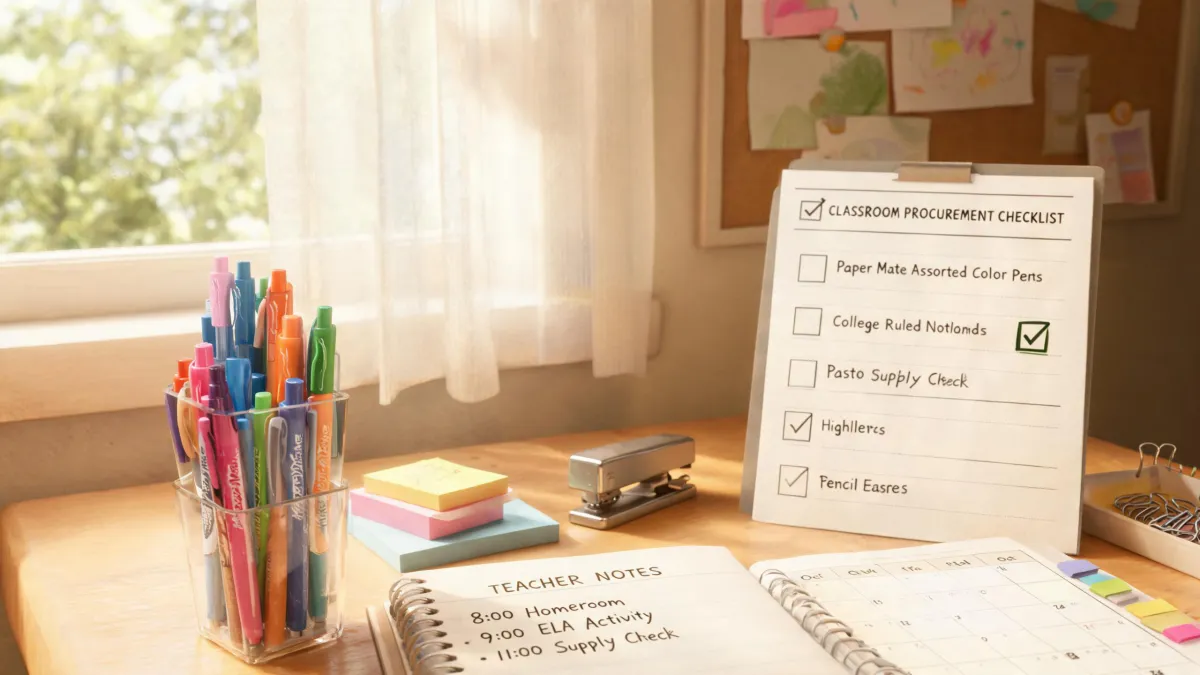
There's a cup on my desk that holds seventeen pens. I counted last week. Twelve of them are Paper Mate. Nine are dead.
Nobody threw them out. That's the thing—they just sat there, dried out, past the point of writing. Everyone reached for them anyway, got nothing, and grabbed another from the supply cabinet. Sounds like a small thing. But I've been managing office supplies for an 80-person accounting firm for six years, and I can tell you: this is not a pen problem. It's a costing problem.
The Problem You Think You Have
"We need more pens." I hear that once a week. Someone walks over, holds up a dried-out Paper Mate, and says it like it's a solution. They order a 24-pack from Amazon, we're set for a few months, and then the cycle repeats.
I used to think the answer was simple: buy better pens, or buy more pens. Maybe both. The budget was there. But in Q2 2024, when I was comparing quotes for our quarterly order, I found something that made me rethink the whole approach.
The quote was pretty standard—unit prices, volume discounts, shipping costs. About $2.80 per dozen for basic ballpoints. But when I looked at our actual consumption data from the previous three quarters, I noticed something odd. The people who complained the most about "bad pens" were writing with the ones that had been sitting in the community cup for months. Not a fresh pen issue. A storage and replacement issue.
The real problem isn't getting pens. It's throwing them away too early.
The Real Problem: Unit Price vs. Total Cost
I don't want to sound like a consultant here. But unit price is a terrible way to buy pens.
Here's an example. In 2023, I compared cost across four vendors. A generic brand offered ballpoint pens at $0.09 each. Our usual Paper Mate was about $0.19. The generic was roughly half the price. My spreadsheet said we'd save $260 on 2,600 pens. My gut said something else.
Why? Because I'd been through this before. Cheap pens walk. They get left in conference rooms. And when they dry out, nobody bothers to revive them—they just open another box. What matters is not the cost per pen. It's the cost per completed page, per signature, per month of actual use.
The generic pens looked fine on paper. But, to be honest, they weren't great. The ink was thinner, the caps didn't grip as well, and people stopped trusting them. So they used them once, decided they didn't like them, and never touched them again. That's not a $0.09 pen. That's a $0.09 pen that wastes about four minutes of human time and then sits in a drawer for six months.
Per-Page Cost Is the Metric You're Missing
If you've never calculated the cost per written page, you're not alone. But you probably use a calculator for things that matter—AP score calculator before a test, bra size calculator before ordering clothes online. All those little tools exist to prevent regret. Yet when we buy office supplies, we rely on "looks cheap" and call it a day.
I built my own cost-per-page metric after getting burned by exactly that logic. It's not a formal formula. It's a sanity check: (box price + shipping + restock effort) ÷ estimated usable pages. And it consistently shows that a reliable pen you keep for months beats a cheap one you replace every two weeks. Not because the pen is better. Because the overhead of replacing it is worse.
Dried-out tips are part of this too. If a Paper Mate ballpoint has been sitting in a hot car for a week, it will often start skipping. The fix? Sometimes you can revive dried out Paper Mate ballpoint pen tips by scribbling firmly on scrap paper for ten seconds. The friction warms the tip and gets the oil moving again. If the pen has been dead for months, that trick probably won't work. But if it's just started skipping? Worth the ten seconds.
Why does this matter? Because a skipped line on a client-facing document can mean reprinting the whole page. That's paper, toner, time. In an accounting firm, time is money. A ten-second fix is cheaper than a new pen—and much cheaper than a reprint.
What This Costs in Real Money
Let's get back to my desk. The cup of seventeen pens, nine dead. I finally counted them because I was auditing our 2023 office supply spending. What I found wasn't one big bill. It was hundreds of small ones.
According to USPS pricing effective January 2025 (usps.com/stamps), a First-Class Mail large envelope costs $1.50. When you add packaging and internal handling, a small office supply order can easily cost $8–$12 just to move. Do that every month and you're paying the equivalent of several boxes of pens in logistics alone.
Every one of those small replenishment orders—the "we need pens by tomorrow" ones—came with shipping fees. Add them up over a year, and it's easy to spend $400–$600 just to move boxes around. I audited our 2023 spending and found that about 18% of our office supplies budget went to shipping and rush fees, not the actual products.
Then there's the time tax. Each order had to be approved. Someone had to open the box, refill the cabinet, collect the dead pens. Every time an office manager does that, it's labor cost. It doesn't show up in a budget line, but it's real. After tracking every invoice for six years, I'm convinced the "cheap" option is often the most expensive one.
Timeline pressure makes it worse. In Q4 last year, we needed pens for a client event, and I had two hours to decide before the rush cutoff. Normally, I'd get quotes, compare shipping, check our usage data. But with the deadline, I went with our usual vendor and paid for overnight delivery. In hindsight, I should have planned better. Hindsight is a luxury.
This is where total cost of ownership (TCO) thinking comes in. It's not just the unit price. It's:
- Shipping, repeated
- Time spent ordering and restocking
- Pens that disappear before they run out
- Documents ruined by skipped ink
- The cost of losing trust in a product that fails at the worst moment
That last one is hard to measure. You won't see it in a spreadsheet. But I learned it the hard way.
So glad I double-checked the quantities before approving a recent order. I almost signed off on ten times what we needed because the vendor's pricing sheet listed per-unit prices in columns and my quick math misread the volume discount. One click would have bought $1,800 worth of pens for an 80-person firm. Not ideal. Dodged a bullet.
The Fix (Keeping It Short)
Here's what I've changed, and it's not complicated.
Buy at the Right Level, Not the Fastest Level
For basic office use, we buy Paper Mate ballpoints in bulk—24-packs from Amazon. Amazon Paper Mate pens in that size are competitive on price, but the real win is fewer orders and fewer shipping costs. I only do this when I know actual usage from our inventory log, not from guesswork.
Match the Pen to the Task
Community cup? Ballpoint. Client-facing? Gel or rollerball. A better pen for important documents costs less than reprints caused by a budget pen that fails mid-signature. That's TCO thinking.
Revive Before You Replace
If a Paper Mate starts skipping, try the ten-second scribble trick before tossing it. If you have a stack of dried-out ones, go through them once and scribble on scrap paper. You won't fix every pen—honestly, maybe half. But half a box of pens you don't have to buy is still something.
For the Occasional Fountain Pen User
If someone in your office uses fountain pens, learning how to eyedropper convert a fountain pen can cut ink costs to a fraction of cartridge refills. It's a niche DIY, but it's a perfect example of total cost thinking: a little one-time effort, a big per-use saving.
Run the Numbers You Run for Everything Else
You used an AP score calculator for a test. You used a bra size calculator to order something online. Fine. Take that energy to your office supplies. Calculate cost per usable pen, not just price per box.
That's the whole fix. It's not exciting. But the problem was never the pens. The problem was treating a $0.19 pen drying out as a fact of office life instead of a cost that can be managed. Once you start calculating, you stop grabbing the next box.
Next time you see a dried-out pen in the community cup, count how many are in there. That's the first step.