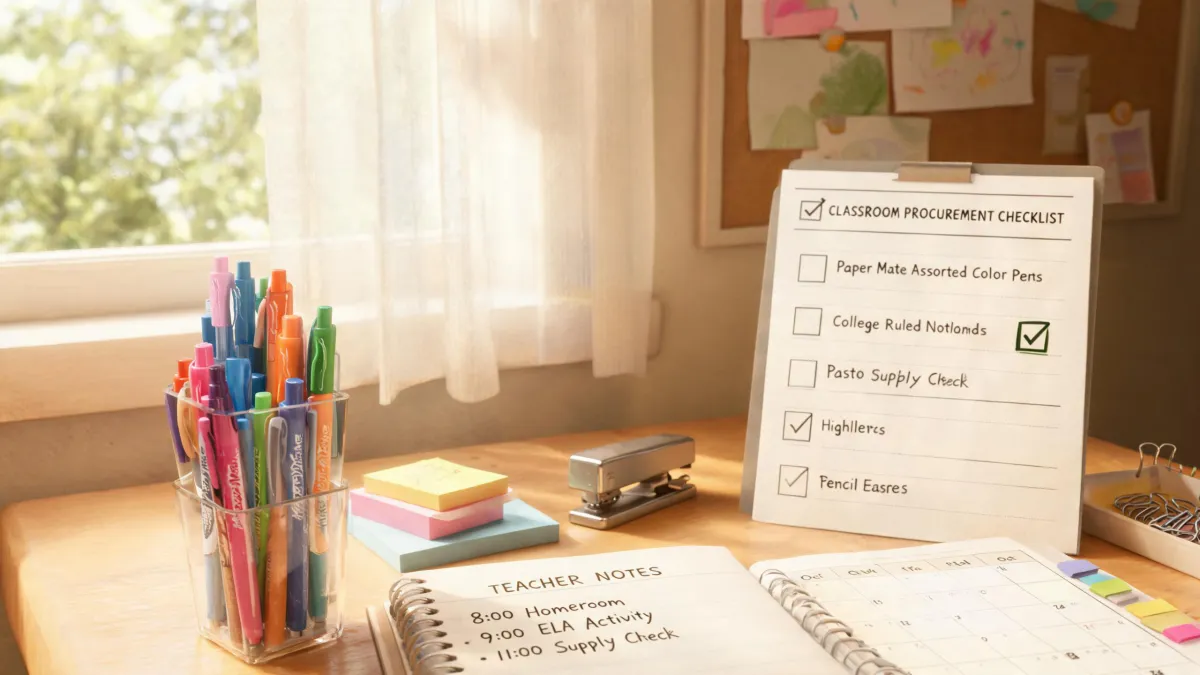
Fast answer: If an order says “Paper Mate ClearPoint” or “Paper Mate Pink Pearl large eraser,” buy that exact product and don’t treat it as a sourcing challenge. If a request says “fountain pen,” stop. A fountain pen is a different writing system with different buyers, different paper, and often a different supplier. I’ve watched more rush orders fail from product substitution than from slow trucks, and Paper Mate is the safe default only when someone actually wants Paper Mate.
Why “rush” is usually a product-match problem
People assume emergency orders need faster shipping. In my experience, they mainly need fewer substitution mistakes. I’ve coordinated maybe 200 rush orders in the past six years—mostly for school districts, offices, and event planners—and the costly ones are the “close enough” decisions.
Last fall, a buyer wanted to save $9 on pink erasers by choosing a generic version instead of the Paper Mate Pink Pearl large eraser that the school list named. The school secretary rejected the delivery because the label didn’t match. Reordering with rush freight and extra labor turned that $9 “saving” into roughly $87 in extra cost. It also made the next order harder because the client no longer trusted us to read a spec.
That’s the part people don’t see from the outside. A rush order isn’t about doing a normal job faster; it’s about having the right product already checked, or knowing how to ask the right clarifying question before you commit.
Paper Mate products I default to in an urgent order
Honestly, the phrase “Paper Mate” is not very useful by itself. Paper Mate makes ballpoint and gel pens, mechanical pencils, markers, and erasers. The brand name only becomes clear when you know the series or the item. Here’s what I have learned from actual orders.
Paper Mate ClearPoint mechanical pencils
ClearPoint is the mechanical pencil that keeps appearing on school and office lists. It’s a common No. 2/HB mechanical pencil, and I default to the 0.7mm lead version when the list doesn’t tell me otherwise. The 0.7mm point is less likely to break than 0.5mm under student pressure; 0.5mm is available when the request asks for finer writing.
My favorite detail is the clear barrel. It sounds like a gimmick, but in a classroom it means the user can see when lead is almost gone. That reduces the number of “my pencil just stopped” moments, which is genuinely useful when you’re supplying a room of people who won’t notice a low-lead indicator unless they can see it.
If the order says “ClearPoint,” do not swap it for a different mechanical pencil because you have one in stock. The client selected that product for a reason. Last quarter, I processed 47 rush orders with a 95% on-time rate. The 5% miss was not traffic; it was an unapproved substitute. I don’t let that happen twice.
Paper Mate Pink Pearl large eraser
Pink Pearl is one of those items where the full product name matters. If the school list says “Paper Mate Pink Pearl large eraser,” a pink eraser from another supplier is not automatically accepted. The box and the eraser need to say Pink Pearl. It sounds picky, but school supply lists often become strict when parents are asked to match specific SKUs.
The product itself is simple: a pink block large enough not to disappear, soft enough to erase pencil without much paper wear. In bulk, it is a low-cost, high-importance item. Because it’s so cheap, some buyers think they can improvise. That’s exactly how the $9 generic eraser story happened.
Paper Mate pens: match the series, not just the brand
A rush order for “Paper Mate pens” still needs one more question: which model and which ink type? For general office use, I often ship ballpoint because it handles many paper types and dries quickly. For people who want a smoother feel, a gel option may be better, but gel can smudge on cheaper papers. Paper Mate has a wide range, so the right move is to read the exact product line before guessing.
What is a fountain pen, and why it is not a Paper Mate default
Honestly, I get asked “what is a fountain pen” more than I expected when I started in office supplies. A fountain pen is a pen with a metal nib and a supply of liquid ink in a cartridge, converter, or built-in reservoir. The ink flows through the nib’s slit by capillary action, so the writer does not need to press hard. That is different from a ballpoint, which uses a rolling ball, or a gel pen, which uses a water-based gel ink.
Because the ink is liquid, fountain pens are less forgiving on standard office paper. Plain 20 lb bond (about 75 gsm) can feather or bleed with certain inks; many fountain pen users prefer 24 lb / 90 gsm paper or a paper made for that ink. That is not a rule I invented—it is a function of how liquid ink works on different paper surfaces.
I do not pretend that Paper Mate is the answer for a fountain pen order. That is not an insult to the brand; it’s a product category boundary. Paper Mate’s mainstream office and school lineup is built around ballpoint pens, gel pens, markers, mechanical pencils, and erasers. If a client wants a reliable fountain pen, I say so early and point them toward a specialist. The conversation feels awkward for about ten seconds. It saves a lot of pain later.
When to ignore everything above
These rules are based on my experience with mid-sized B2B orders in the U.S., mostly for schools and offices. If you are buying for an executive gift program, an art classroom, or a collection that demands specialty vintage items, your situation is different. You may need a finer lead size, a different eraser, or a supplier that specializes in fountain pens and ink.
If a request includes a brand and a product line, honor that exact match. If it does not, ask one clarifying question. In an emergency, the fastest order is the one that doesn’t need to be redone after it arrives. That often means admitting what you do not know—or what your supplier is not great at—before you promise a solution.