It's 8:15 on a Monday morning. The caller is a program director at a children's literacy nonprofit, and her family reading night is 36 hours away. The request sounds simple: 300 Paper Mate medium point pens printed with the organization's logo.
If she'd called the previous Tuesday, this would have been a routine order. She didn't. By Wednesday, I was triple-checking lanyard stock, hunting down a Pokemon binder, and staring at a printer that could not fax a signed approval. That's when it hit me: the pens were never the real problem.
For context, I coordinate rush orders for a regional office supply distributor. In the past 11 years, I've handled roughly 200 emergency orders—from an $80 missing-pen replacement to a $15,000 back-to-school project. Last quarter alone, we processed 47 rush orders, and 95% of them arrived on time. So I'm not complaining about urgency. I'm saying urgency usually hides something else.
Why the pens were the decoy
Here is what actually showed up on the final purchase order:
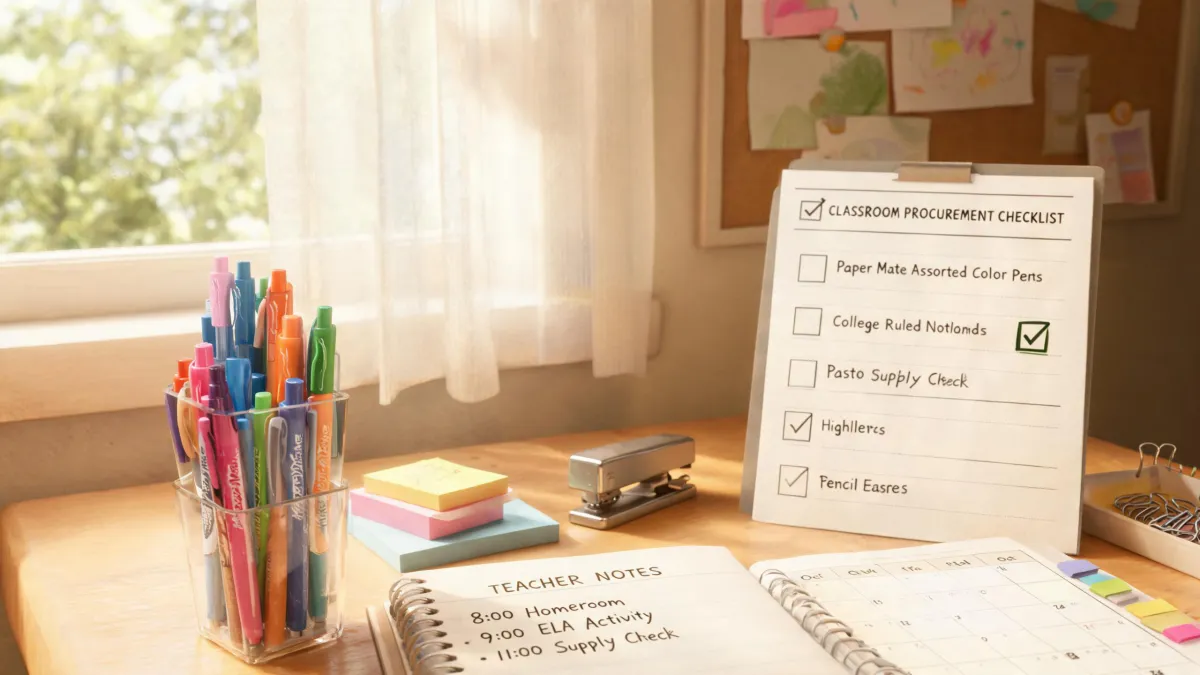
300 Paper Mate InkJoy medium point pens, custom printed
12 boxes of Paper Mate pens refills
50 blank lanyards for volunteer badges
20 Pokemon binders for door prizes
That assortment looks scattered, but it's not unusual. Schools, nonprofits, and offices rarely call about one item. They call about a room full of people and a deadline attached to it. The mistake is assuming that because one person can order everything, the whole order moves on one timeline.
The Paper Mate pens were easy to source. Blank lanyards were easy too. Even the Pokemon binders were easy, as long as we treated them as retail door prizes and did not try to print a logo on licensed artwork. I'm not a trademark attorney, so I can't speak to what a formal licensing agreement allows. What I can tell you from a procurement perspective is simpler: if someone else owns the characters, we don't add branding to them.
The part that looked easy—the custom printing—was the part that almost broke the timeline. Anyone can order 300 medium point pens from a catalog. But when a pen needs a logo, the process changes completely. The logo has to be checked, converted, proofed, and approved before it touches a barrel. That step does not care how urgent your event is.
The deeper problem was the stuff nobody checked
There were three hidden failure points, and none of them involved pen availability.
The first was artwork. The nonprofit's logo existed as a 640-pixel-wide JPG pulled from their website. On a computer screen it looked fine. On a pen barrel, at print size, it was borderline. Commercial print generally wants 300 DPI at final size, and vector files are even better. A tiny logo image that looks acceptable in an email signature will not magically look better when it is printed on a curved pen barrel.
Color was another unglamorous detail. The client said, "just match our blue." There is no universal "blue." For brand-critical colors, the industry uses Pantone. Pantone 286 C, a common corporate blue, converts to roughly C:100 M:66 Y:0 K:2 in CMYK—but that conversion is a starting point, not a promise, because results vary by material and printing method. Most buyers focus on per-unit price and miss that color matching and art preparation are what actually delay a job.
The second failure point was the lanyard. We had blank lanyards in stock and could ship them immediately. That solved the immediate problem. But if the group had wanted custom-printed lanyards, the lead time would have been completely different from the pens. Nobody had asked whether all the items shared the same production calendar. They didn't. When you put items with different lead times on one order, the slowest item controls the whole delivery.
The third failure point was the fax machine. The signed approval page was sitting on a desk. The grant administrator needed it by 5 p.m. The nonprofit had a multifunction printer that claimed to fax. It was only when someone finally asked, "how to fax from this printer?" that we discovered there was no dial tone. The machine had never been connected to a phone line. We ended up scanning the document and emailing it, which worked in this case. But the panic was real, and it was avoidable.
What the last-minute decision actually cost
I don't want to overdramatize. The event happened. The pens arrived. The volunteers had lanyards, and the Pokemon binders were handed out to very excited kids.
But the nonprofit spent an extra $612 in rush fees and after-hours proof approvals across three vendors. I can quote that number because I processed the invoices. That was money taken from the same budget that buys books. The rush did not need to happen. The pens themselves could have shipped quickly from local stock. What needed to happen earlier was the verification work: check the artwork, check the licensing, check the fax connection, and check that every item on the order had a realistic lead time.
In my experience, most office emergencies are not caused by slow suppliers. They are caused by small assumptions that sit unchecked until the deadline is close enough to create panic.
Prevention beats last-minute correction
I am not going to tell you that every order needs to be planned three weeks in advance. That is not realistic. But I will tell you what I tell every client who calls in a rush:
- Send the actual print-ready logo before you ask for a delivery date. A five-minute file check can save five days of correction.
- Ask which items are custom and which are stock. Custom items set the real timeline.
- Add Paper Mate pens refills to the same order if you are even slightly low. Refills are cheaper than a second emergency order three weeks later.
- Test your printer's fax and scan functions before you need them. Five minutes of verification beats five days of correction.
- If a product has licensed characters, treat it as a retail item, not a blank canvas for your logo.
Paper Mate pens are rarely the emergency. The emergency is almost always something smaller and less exciting: a logo that will not print, a signed page that will not send, or an assumption that every product on one order moves at the same speed. Once you start looking for those, the so-called rush orders start looking a lot less scary.