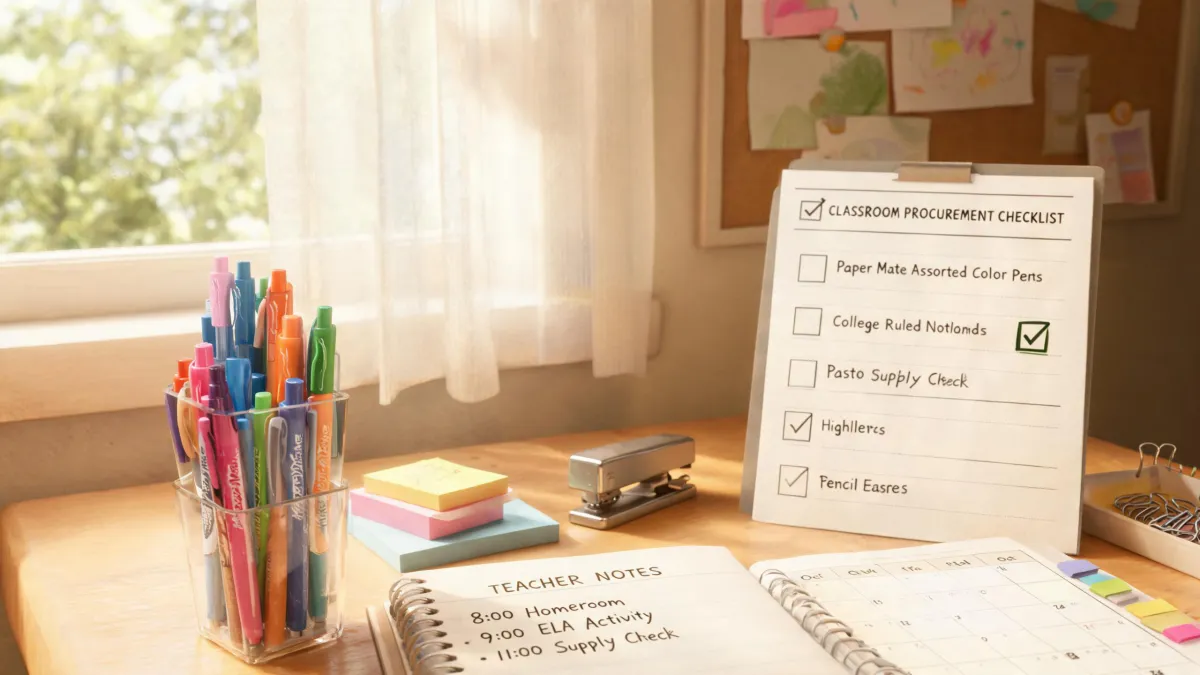
When you're ordering Paper Mate pens for the office—whether it's a bulk of InkJoy 300 RT ball pens or a full set of Flair colors—the question isn't just which pen. It's when you need them, and how much that timeline is worth. I've been coordinating bulk office supply orders for about six years, and I've had my share of close calls. This article lays out the two main procurement strategies—Standard and Rush—and compares them across three key dimensions: time certainty, total cost, and stress. No fluff, just the trade-offs.
The Comparison Framework: Standard vs. Rush
We all know the drill. Standard procurement means ordering at the lowest per-unit price, waiting the standard turnaround (usually 3–7 business days for products like Paper Mate Flair pens), and hoping nothing slips. Rush procurement means paying a premium—sometimes 20-40% more—for guaranteed delivery in 1-2 days. The difference isn't just speed. It's certainty. And in my experience, that is what you're really buying.
Dimension 1: Time Certainty
Standard Procurement: The vendor says "ships in 3-5 days." But that's an estimate. I've seen it stretch to 7 days—or longer—when inventory dips on a popular item like the Paper Mate InkJoy 300 RT ball pens.
Rush Procurement: The vendor gives a hard deadline, often with a tracking number the same day. In March 2024, I needed 500 Paper Mate Flair pens—all colors—for a client's summit with 36 hours' notice. Standard turnaround was 5 days. We paid a 30% rush premium and had them in hand the next afternoon. The client's alternative was canceling the welcome kits, which would have cost them their sponsor placement.
The Conclusion: For time-sensitive orders, the estimate from standard procurement is a risk. Rush procurement buys you a guarantee—not just speed.
Dimension 2: Total Cost vs. Value
Standard Procurement: The per-unit price is lower. For a case of Paper Mate InkJoy 300 RT pens, standard pricing might be $0.60 per pen versus $0.80 for a rush order. On 1000 pens, that's a $200 savings.
Rush Procurement: You pay more upfront—but you avoid the hidden cost of delay. Last year, our team lost a $12,000 contract because we tried to save $300 on a standard order of customized pens. The delay meant the client's event started without their branded giveaway. After that, we budgeted for rush fees on deadline-driven orders.
(Should mention: total cost of ownership includes rush fees and potential reprint or reorder costs if the standard timeline slips.)
According to USPS pricing effective January 2025, First-Class Mail postage for a 1 oz letter is $0.73—a fixed cost that doesn't change whether you ship standard or priority. The same principle applies to procurement: the price certainty of rush is often worth the premium, especially when the alternative is a missed deadline worth thousands.
The Conclusion: Standard looks cheaper, but the value of rush comes from avoiding the cost of uncertainty. If the risk of a delayed order is high, rush wins on total cost.
Dimension 3: Stress and Peace of Mind
Standard Procurement: There's no immediate pressure—but there is lingering doubt. "Did they ship on time?" "What if inventory is low?" This is the kind of stress that builds over days. I've had administrators tell me they check tracking eight times a day on standard orders for a big event.
Rush Procurement: You pay a premium, but you get immediate confirmation. The stress shifts from "will it arrive?" to "did I order the right thing?"—which is a much smaller load. In my first year, I made the classic error of assuming standard delivery would be fine for a conference order. When the shipment didn't arrive, I spent 12 hours calling vendors and paying $400 extra for overnight shipping. Lesson learned: rush upfront is cheaper than rush frantic.
FTC guidelines require that delivery claims be truthful and substantiated, so a rush guarantee backed by a major vendor is more credible than a standard "estimated" date.
The Conclusion: For the cost of a minor markup, rush procurement converts days of anxiety into hours. For anyone managing office supplies under deadline—event planners, facilities teams, executive assistants—that peace of mind is real value.
Choosing Your Path: Scenarios
So which strategy fits? It depends on your timeline and tolerance for risk.
- Choose Standard if: You have at least 10 business days lead time, the order is not event-critical, and you can accept a 1-2 day slip without major consequences. For routine restocks of Paper Mate Profile or Clearpoint mechanical pencils, standard is fine.
- Choose Rush if: Your deadline is under a week, the items are for a specific event or client, or the cost of delay is greater than the rush premium. When you're ordering 500 printed Paper Mate InkJoy 300 RT ball pens for a trade show, rush is the safer bet.
Bottom line: I've been burned twice by "probably on time" promises. In the office supply world, where the margins are tight and the deadlines are real, paying for time certainty is rarely a mistake. I should add that I've seen more than a few teams save money by planning ahead—but when you can't, rush isn't a luxury. It's insurance.