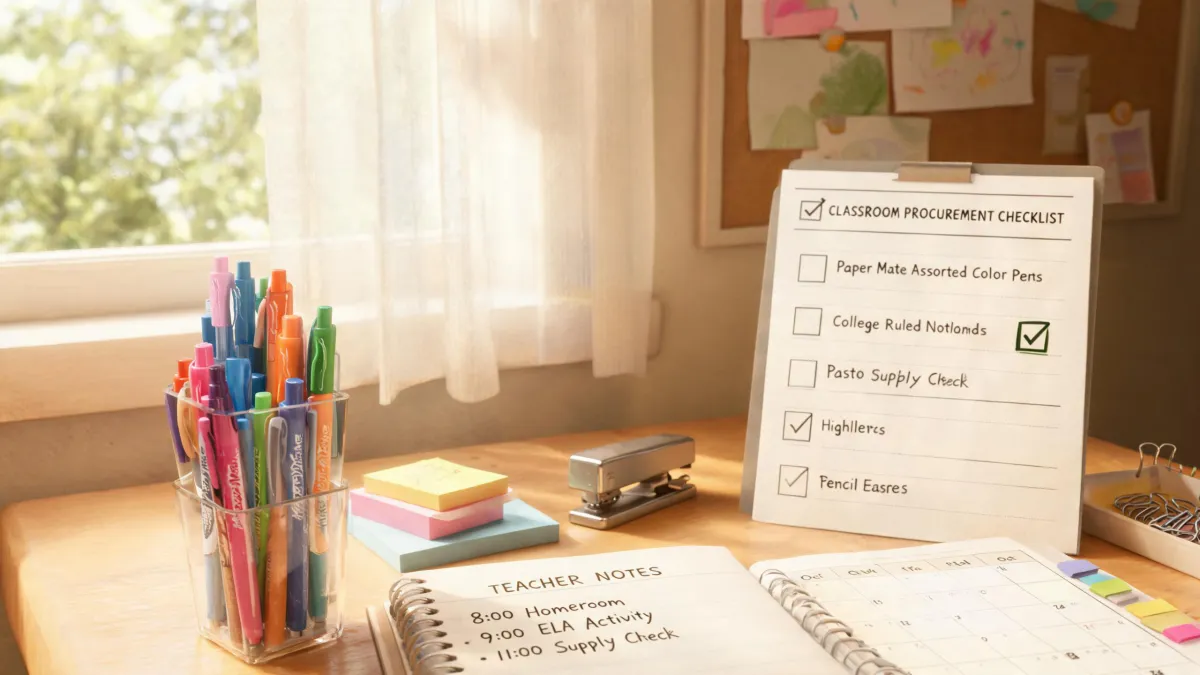
Here's the thing about office supplies: if you're comparing them by unit price, you're doing it wrong. Not kind of wrong. Expensively wrong.
I coordinate emergency supply orders for offices, schools, and event teams. In eight years, I've processed more than 300 rush orders. That's a weird job to have, because by the time someone calls me, the "cheap" option has already failed. I'm the person you call at 3:00 PM when the pens you bought in bulk all skip, and the contract signing is tomorrow morning.
So I'll say it plainly: The cheapest office supply is rarely the cheapest thing you'll buy. The real price includes the time you spend managing it, the work it disrupts, and the risk it creates. This isn't a lecture about budgeting. It's a survival skill.
The Unit Price Illusion
It took me about four years and 150 orders to understand this fully. Early on, I was the person who sorted vendor quotes from lowest to highest. That's how I was taught. And it cost me.
What most people don't realize is that a unit price only covers the product. It doesn't cover the time your office manager spends ordering replacements, the lost minutes when a pen stops writing in the middle of a note, or the cost of the emergency delivery you need because nobody checked the inventory.
Here's something vendors won't tell you: the first quote is almost never the final number that matters. The $6 box of pens that lasts three months is cheaper than the $3 box that lasts two weeks, because you'll buy the $3 box six times. You can see where this is heading.
What I mean is this: a unit price is just the entry fee. The real cost comes from whether the pen writes every time, whether your office manager can reorder it easily, and whether it's likely to fail at the worst possible moment. By that measure, a $2 pen can be an outrageous luxury and a $0.80 pen can be a bargain.
I didn't start with this view. I started with a spreadsheet and a low-to-high sort, like every other rookie buyer. The shift happened when I had to explain to a client why we were rushing 48 replacement pens overnight because their bargain option had failed on arrival.
I now calculate total cost of ownership before I compare anything. That means:
- Unit price, but only as a starting point.
- Replacement frequency based on how long the product actually lasts.
- Time cost for the person who has to reorder or fix it.
- Risk cost if it fails at the worst possible moment.
Not complicated. But almost nobody does it.
A $40 Mistake I Still Kick Myself For
One of my biggest regrets is approving a bulk purchase of discount pens to save about $40 on a $400 office order. The pitch was easy: same number of pens, lower price, who cares about the brand? I cared, apparently, but not enough.
The pens were fine for the first week. Then they started skipping. Then the gel ones started exploding in drawers, and I don't mean in a poetic way. I mean ink everywhere, the kind of mess that requires wiping down three desktops and a keyboard.
We replaced them eleven weeks later. I still kick myself. If I'd spent $60 more on pens with a known record, I would have avoided about $130 in reorder costs, staff complaints, and the quiet rage of the office manager who cleaned the keyboard.
In March 2024, 36 hours before a client launch event, the custom branded pens the client ordered from a budget supplier were all defective. Every single one skipped. Normal replacement delivery: five days. We found a local vendor who could supply Paper Mate pens from a nearby warehouse, paid $182 in rush fees on top of the $390 base cost, and delivered to the venue by 7:30 AM. The client's alternative was a launch table with no working pens. For a team collecting feedback forms and NDAs, that wasn't an option.
Call it a penalty of $572. Or call it the real price of buying on sticker price.
Why I Standardize on Paper Mate
I'm not here to tell you Paper Mate is the only brand that works. I'm telling you why I keep coming back to it in emergency situations: consistency.
When a client asks for "paper and mate pens," I don't correct them. I know they mean Paper Mate pens, and the search phrase doesn't bother me. Whether you type "Paper Mate" or "paper-mate" with a hyphen, it's the same brand. I've typed worse things on a Tuesday. The point is that a well-known product line removes uncertainty.
That's why I built my emergency order templates around Paper Mate InkJoy pens, Paper Mate Flair felt-tip pens, and Paper Mate Profile Mech pencils. Not ideal in every situation, but workable. The Profile Mech pencil, in particular, is in every backup kit we stock because it doesn't need to be great. It needs to not fail. That's a different standard, and it's the standard that matters during a crisis.
Before you ask: no, that doesn't mean expensive pens are always worth it. It means predictable and available beats cheap and unreliable.
The Printer Setup Tax
Now for the part that surprises people: office supplies aren't just pens and paper. Time is a line item too, and technology is where it goes to die.
Last quarter, a client's office manager spent half a day searching for instructions on how to connect canon printer to wifi after a firmware update. Half a day. That's four hours of her salary, plus the frustration, plus the printing queue that backed up while she was searching. The total cost of that printer moment was higher than the office's pen budget for three months.
Here's what I mean by that: the $89 printer was a fine deal. The $29 generic cable was fine. The time it took to configure them was not fine. In TCO terms, the setup cost swamped the purchase price. Nobody in the office walks around saying "we paid a printer setup tax." It just shows up as a blocked calendar, a support chat, and a delayed supplies order. That's still a cost. You just can't see it on a receipt.
And the same logic applies to a simple dry erase board. A cheap dry erase board might ghost after a few months. Your team can't read the project schedule; they ask each other; someone erases the wrong thing; now you have a miscommunication. If the surface ghosts, people start taking photos of the board before they erase it. Those photos go into group chats. The schedule becomes multiple versions. You don't see that cost on the receipt, but you pay it.
This is the same pattern I see when I compare print services. Publicly listed prices as of January 2025 put 500 standard business cards at $20–35 at budget online printers, $35–60 at mid-range, and $60–120 for premium cards with thick stock. Rush delivery typically adds 25–50% for 2–3 days, based on publicly listed fee structures as of January 2025. The low quote never includes the cost of speed. You don't wait until the deadline to discover that "cheapest" was a temporary word.
Highlighters and the "Vape" Diversion
I need to address a search phrase I keep seeing: highlighter vape. To be clear, a highlighter vape is not a real product. I'm certain because I once spent 20 minutes looking, which is exactly the kind of time sink I'm talking about. Real talk: what people actually need is a highlighter that doesn't dry out after two weeks. That's a much less interesting search result, but it's the one you'll remember when you're marking up a contract and the ink is already pale.
This is a perfect example of total cost thinking: small items, easy to lose, cheap to replace individually, surprisingly expensive to manage repeatedly. The $1.50 highlighter is fine if it stays in the drawer. But if your team loses them weekly, the reorder cost and restock time add up quickly. Same with cheap pens. Same with dry erase markers that go missing from conference rooms.
What About the Cheapest Option?
Look, I'm not saying budget options are always bad. Sometimes the cheapest option is genuinely the right one. If you're buying pens for a trade show giveaway table, a basic pen with the company logo is fine. If you're buying pens for a bank's mortgage closing desk, the math is different. TCO is not a rule that says "always buy premium." It's a rule that says "count the real costs before you decide."
People who disagree often argue that unit price is a good enough proxy. I used to think that too. Then I paid for it with a clogged drawer, a dead whiteboard, and a half-day printer saga. Sometimes the expensive thing is the lesson.
The Bottom Line
I'm not going to soften this: if you're buying office supplies by unit price alone, you're paying too much. It just doesn't feel that way because the invoice doesn't show the reordering, the lost time, or the failed launch table.
It took me eight years and a lot of rush orders to get this through my head. I hope it takes you less time.
Buy what works. Count what it costs to keep it working. The number that matters is the total cost, not the sticker price.