Tuesday morning, 9:15 AM. A new hire named Amy poked her head into my office and asked, "Is Paper Mate InkJoy a gel pen?"
I should have been able to answer that. I manage office supplies for a 12-person marketing team. Pens are kind of my thing—or so I thought.
The honest answer? It depends which InkJoy you mean. The InkJoy Gel series is a gel pen. The InkJoy Ballpoint series is a ballpoint. And the InkJoy 700 RT, the one Amy's team had requested, uses a low-viscosity ink that writes more smoothly than a standard ballpoint but isn't classified as a gel. That thirty-second conversation should've ended there. Instead, it became the gateway to a two-week mess involving Paper Mate Flair Metallic pens, a permanent marker, and a streak of bad decisions that cost us roughly $960.
The InkJoy Discovery
When Amy asked the question, I gave her a confident "I think so?"—which immediately made me question everything. I went down the research rabbit hole, reading product listings and spec sheets for nearly an hour. The distinction between gel and ballpoint matters more than you'd think. Gel ink is vibrant and smooth, but it sits on top of the paper longer and can smudge on glossy surfaces. Ballpoint ink dries faster and writes more firmly, making it a better choice for left-handed writers or quick note-taking.
The problem: I figured all this out after placing the order. Amy's team needed the Gel pens for client handouts printed on coated paper. I ordered the Ballpoint version by mistake, mixing up the product codes. The handouts came in, Amy grabbed a pen to sign her section, and the ink sat on the page a full ten seconds before smearing under her hand. The client saw it. The client literally saw the smear. I wanted to disappear under the conference table.
That reprint cost $178 at rush rates. The right pens would've been $62. (Should mention: the ballpoints themselves were fine—just wrong for the task. That's on me, not the pen.)
Paper Mate Flair Metallic: The Ordering Mistake That Snowballed
A week later, the design team needed Paper Mate Flair Metallic pens for a client workshop. You know the kind—felt-tip markers with shimmering metallic colors, gold and silver and bronze, perfect for name cards and poster accents. A Flair Metallic 4-pack was around six dollars, if I'm remembering right.
While I was on the ordering page, I noticed a discount on permanent markers. We had a few empty spots in the marker drawer. So I added a pack to the same cart. Seemed efficient at the time.
Workshop day arrives. Someone grabs a marker from the communal table to write the agenda on the conference room whiteboard. It's a permanent marker. The board had seen permanent marker before and always cleaned up fine. But this time the ink sat for hours before anyone tried to wipe it off. The next morning, the agenda was embedded in the porous surface like it had been engraved.
Permanent Marker Strain
The permanent marker strain was real, in every sense of the phrase. The stain stretched across half the whiteboard; the strain stretched across our whole afternoon. We tried whiteboard cleaner. We tried rubbing alcohol. We tried the internet's favorite hack—hand sanitizer and paper towels—which honestly got us about 80% of the way there after twenty solid minutes of scrubbing.
The board survived. My dignity, debatable. The bigger cost? We lost a full day of prep. Plus, the account executive who leaned against the edge of the board while the ink was still wet ended up with a permanent magenta stripe on her $85 blouse.
Add it up: $85 for the blouse, a full workday of two people scrubbing and rewriting materials, and a $300 whiteboard that came inches from being replaced. All because I lumped two unrelated marker types into one impulse purchase. (Note to self: label the marker bins. Dry-erase left, permanent right, always.)
The Colored Pencil Subplot
If that week had a theme, it was "pigment problems." Our intern Liam appeared at my door with the panicked look interns get when they've done something they can't undo. Someone had used colored pencils to mark up a printed prototype meant for a client presentation—and the prototype had accidentally gone out with the rainbow annotations visible.
Liam's exact question, phone already open: "How to erase colored pencil?" He hit enter on the search and looked at me like I was supposed to have the answer.
We learned, together, that colored pencil is not graphite. Standard pink erasers barely touch it. The wax-based colored core doesn't lift off the page the way pencil marks do. A kneaded eraser helps a little. A vinyl eraser can roll off the top layer of pigment if you're patient. Isopropyl alcohol on a cotton swab dissolves the wax but can damage the paper. We ended up re-printing the entire package.
The reprint itself was $65. The real cost: the scramble to recreate our notes, plus a deeply awkward client call where we explained away the streaks as an "annotation mishap."
The "How Old Am I" Moment
By Thursday of that week, I found myself on some random website with a "how old am I calculator" open in my browser. Not because I'd forgotten my birth year. Because I genuinely felt like the previous four days had aged me a decade. I'm 39. The calculator said 39. My back disagreed.
I want to say that age-calculator thing was a one-time lapse into self-pity, but honestly, I've pulled it up twice since. When you've spent the week putting out fires that were entirely avoidable, there's something almost comforting about confirming you're still the same age you were on Monday.
The Real Cost of Getting It Wrong
Let's do the math no one wants to do in the middle of a crisis week:
- $85 – Replacement blouse for the account executive
- $62 – The correct InkJoy Gel pens (which, yes, we re-ordered)
- $178 – Rush reprint of the client handouts
- $65 – Rush reprint of the prototype package
- $240 – Rush order for the Flair Metallic pens and workshop supplies because our timelines had blown up
- $300 – The whiteboard we nearly had to replace
- $30 – Assorted cleanup supplies
Total: approximately $960. For a two-week period where the actual pens and markers involved cost about $45. The products were never the problem. My process was.
Here's where I differ with the "always buy cheapest" crowd. From 11 years of managing office supplies, I can tell you the cheap marker was never the issue. The cheap information was. I saved two minutes by not verifying which InkJoy model was which, and I paid for it with reprints and a stained blouse. The lowest quoted price only means something if the product actually fits the use case. A $1.89 permanent marker that ruins a meeting is not cheaper than a $3.50 dry-erase marker that doesn't.
Total cost of ownership—that's the phrase I use when I talk to new buyers now. It includes the purchase price, the repurchase price when you get it wrong, the time spent fixing the mistake, and the credibility you lose with clients. The cheapest option is rarely the one with the lowest total cost.
What I'd Tell My Former Self
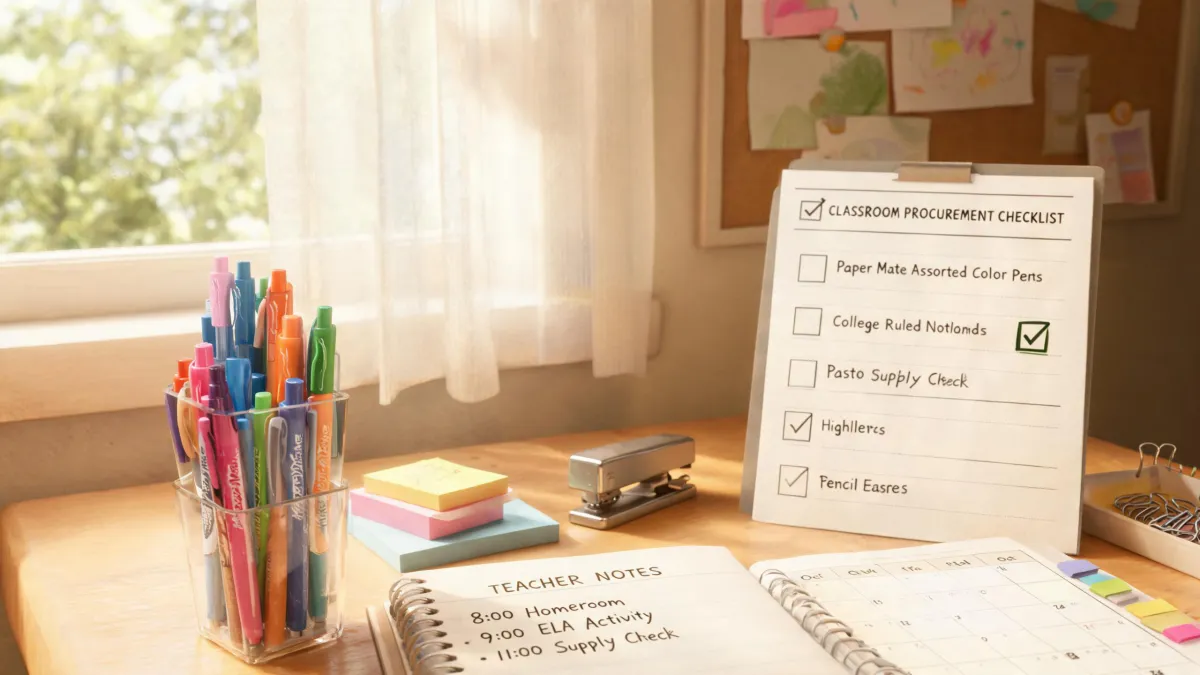
First: label the supply cart. Color-code the bins. Dry-erase on the left, permanent on the right, never in the same cart. When you do a restock, put things in their proper place that day. Future you will be extremely grateful. I've run a pre-order checklist for our team ever since, and in the 18 months after this disaster, it caught 40+ near-misses before they became real problems.
Second: know your pens. Gel and ballpoint are different tools. Gel ink is more pigmented, writes wetter, and needs more drying time—great for notes and desk work. Ballpoint ink dries instantly, needs more pressure, and works better on coated papers and forms. If you don't know which one your team needs, ask. Thirty seconds of conversation saves three figures of rush shipping.
Third: test your materials on the actual paper with the actual supplies before you present to a real client. I know this sounds basic. I know it because I'm the one who skipped it. The "check that the eraser actually erases" step is a ten-minute task that would have saved us $960 and a client-call conversation I will never fully live down.
So, to answer Amy's original question one more time: No, not every Paper Mate InkJoy pen is a gel pen. The InkJoy Gel series is. And if you're ordering them for your team, make sure you know which series you're getting—because the difference between the two is the difference between a smooth experience and a very expensive, very permanent stain on your week.
Worth learning? Absolutely. Worth paying $960 to learn? I'd rather have the money back.