Ask for a smart office purchase recommendation and you'll get a variation of 'just look it up.' Search what is the best printer and you'll wade through 40 listicles with 40 different winners. Search dog age calculator and a website will tell you your 6-year-old Lab is '42 in dog years.' Search tip calculator and you'll get 18% of $86.40 in under two seconds.
It's fast. It's satisfying. And it's mostly useless.
I used to be exactly this person in my first two years running procurement. I compared unit prices. I bookmarked '10 Best' roundups. I calculated everything that could be calculated. My assumption was that the data would point to an objective answer. It didn't. That approach cost us roughly $4,700 in avoidable spending over 18 months, and it took a specific kind of audit to make me see it.
Here's the thing about a dog age calculator: it multiplies one number by seven and presents the result as a fact. It doesn't know the dog is a Great Dane, or that the dog has a heart condition, or that the dog runs three miles every morning. A 6-year-old Dane is old. A 6-year-old Terrier is not. Same input, different reality, because context is doing all the actual work.
Office supply decisions work the same way. Unit price is dog-age math. Simple, quotable, and fundamentally uninterested in context.
Take the printer question, since it lands in my inbox every other week. I can't honestly answer it, because 'best' depends on volume, media type, IT tolerance, and what a page actually costs you over the printer's life. A $1,200 laser is a fantastic choice for a 30-person office that burns through two cases of paper a month. It's an overpriced box of regret for a wedding planner printing 40 pages a week. The printer didn't change. The context did.
Same logic for pens. 'Cheapest pen on the shelf' and 'best pen for eight hours of daily handwriting' are two different products wearing the same disguise. If your team labels boxes for 15 minutes a day, a budget ballpoint is fine. If your team takes meeting notes, updates records, and hand-fills forms for hours, a skip-prone, smudging pen is a daily tax on everyone's patience.
The Calculator Trap
Here's the part that took me the longest to understand, and the part I keep coming back to: a calculator removes the need to reason, and it does it so smoothly that you feel more confident while being less accurate. The dog age calculator saves you from thinking about breed, size, and health. The tip calculator saves you from thinking about service quality. The 'best of' list saves you from thinking about what your office actually does. It's a shortcut that passes for knowledge.
The deeper problem is that a unit price is just another calculator output. It's a real number, but it answers a different question than the one you actually have. The question isn't 'what does this pen cost?' The question is 'what does this pen cost over a year of real use, including reorders, misfires, smudges, and the time people spend replacing things that vanished from their desks?' Everything I'd read in those first two years said to optimize for unit cost. In practice, after audit after audit, unit cost was the least useful number in the system.
What 'Cheap' Actually Costs
Here's the pattern I saw. A twelve-pack of budget pens costs about $0.33 per pen where we order. Looks great on the line item. Then the pens skip on cold days. They write weakly on the recycled paper we use for note pads. They smudge when a left-handed staffer drags their hand across a sentence. They dry out if they sit in a drawer for three weeks. And because they're not pleasant to use, nobody treats them as worth keeping track of. The '12-pack for the floor' becomes '3 pens on the floor' by Thursday. The cheap pen is a throwaway pen, so it gets rebought more often.
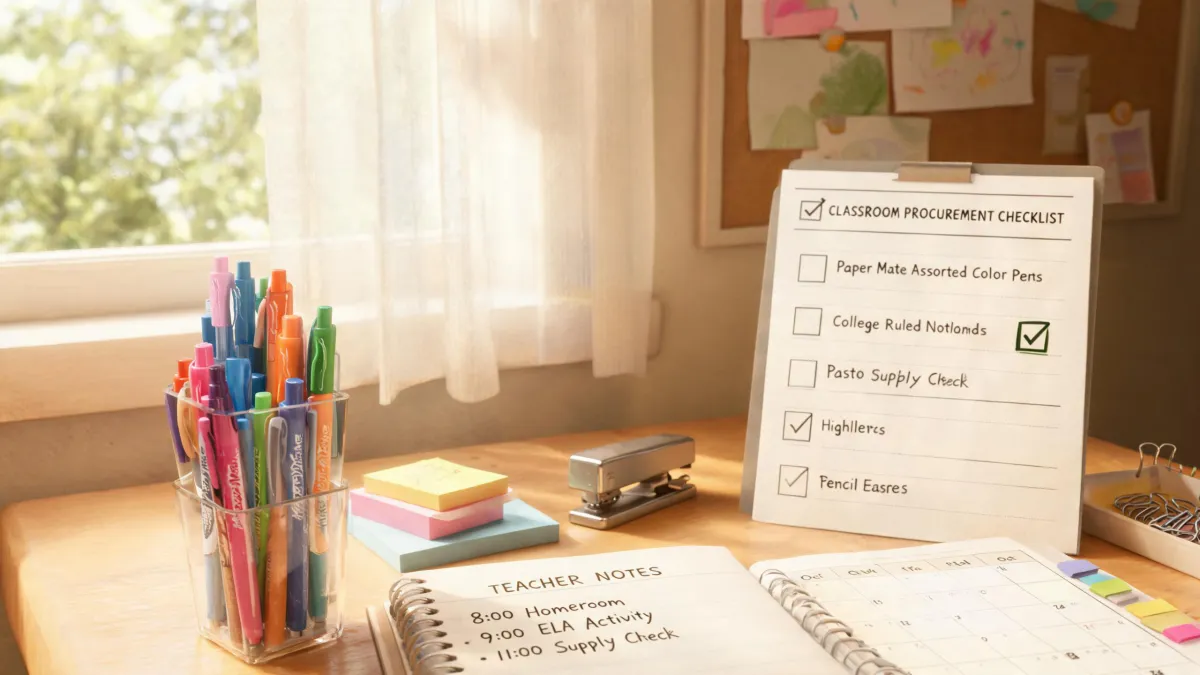
In the 2023 audit, I tracked a full year of writing instrument orders across four departments. The budget-pen orders had a 74% reorder rate within 45 days. The mid-tier pens we introduced in Q3 had a 22% reorder rate over a full quarter. Same quantities, same headcount, different cost trajectory. The Paper Mate handwriting pens we moved to were not the cheapest line in the catalog. They didn't need to be. The reorder savings alone covered the per-unit difference.
The printer math follows the same shape, minus the drama. A $79 inkjet costs $79. Its cartridges are around $45 a set and yield maybe 200 pages before flashing empty. That's $0.225 per page before you factor in the paper jams. A $250 printer with high-capacity cartridges at around $60 for 1,500 pages works out to $0.04 per page. At 500 pages a month, the difference is about $92.50 a month. In under 2 months, the 'expensive' printer has caught up on the $171 price gap. In a year, the budget printer has cost about $1,100 more. But the listicle said 'budget pick' and the decision was closed.
Before you point out the obvious — yes, there are fine budget printers and yes, context matters — you're right. This isn't an attack on a category. It's an attack on letting a single number make a decision that deserves judgment.
The Question That Fixed Our Budget
Here's what changed for me. Before any office supply spend, I ask one question: what is this tool actually doing all day? Not what it costs. Not what the reviewer ranks it. What are the real users doing with it, and what does the tool need to survive?
For our office, the answer for general-purpose writing was the Paper Mate InkJoy fine point line. It's a handwriting pen for daily use, not a specialist instrument. The fine point works well on cheap recycled paper, the ink dries fast enough that my left-handed colleague stopped leaving smudged notes around the office, and nobody complains about hand fatigue after an afternoon of record-keeping. That recommendation came with a risk. The upside was a cleaner supply closet and fewer complaints. The risk was simple: if the InkJoy pens performed worse than the ones they'd replaced, I'd lose the team's trust in the whole ordering process. That's not a trivial consequence. So I built a test order — 100 pens, three departments, one month — before changing the default. The test caught exactly one problem: the 0.7mm tip was too thick for the smaller forms we use. It let us adjust the order before committing to 1,000 units. There isn't one 'best' Paper Mate pen. There's the version that fits your forms, your paper, and your people.
The same starting question applies to the printer problem. If your team prints contracts and shipping labels, you don't need photo-level color accuracy. You need duplexing, dependable paper feeding, and a reasonable cost per page. The question isn't 'what is the best printer.' The question is 'what's the best cost per page for a team of people who print, scan, and misplace documents every single day?' Those are two different searches. They point to two different products.
Five years ago, the 'cheapest thing that doesn't immediately collapse' strategy was at least defensible. The gap between budget writing tools and good ones was wide. That gap has narrowed. Better ink formulas and comfortable grips are priced a lot closer to budget items than they used to be, which changes the math. What was a meaningful saving in 2020 is a rounding error in 2025 — and the quality difference hasn't moved the other way.
One last thing, because I do not want to be one of those 'prices as of forever ago' writers. Everything in this article came from orders I placed, invoices I reviewed, and spec sheets I pulled between September and December 2024. Retail pricing drifts. Ink prices drift even more. If you're building a budget, verify current pricing against your actual vendor before you commit, and recalculate when the product line updates — because it will.
The bottom line is simple: the best purchasing decision isn't the one with the lowest unit price, and it isn't the one a calculator endorses. It's the one that survives contact with your actual office routine. That's not something you can look up. It's something you have to ask.