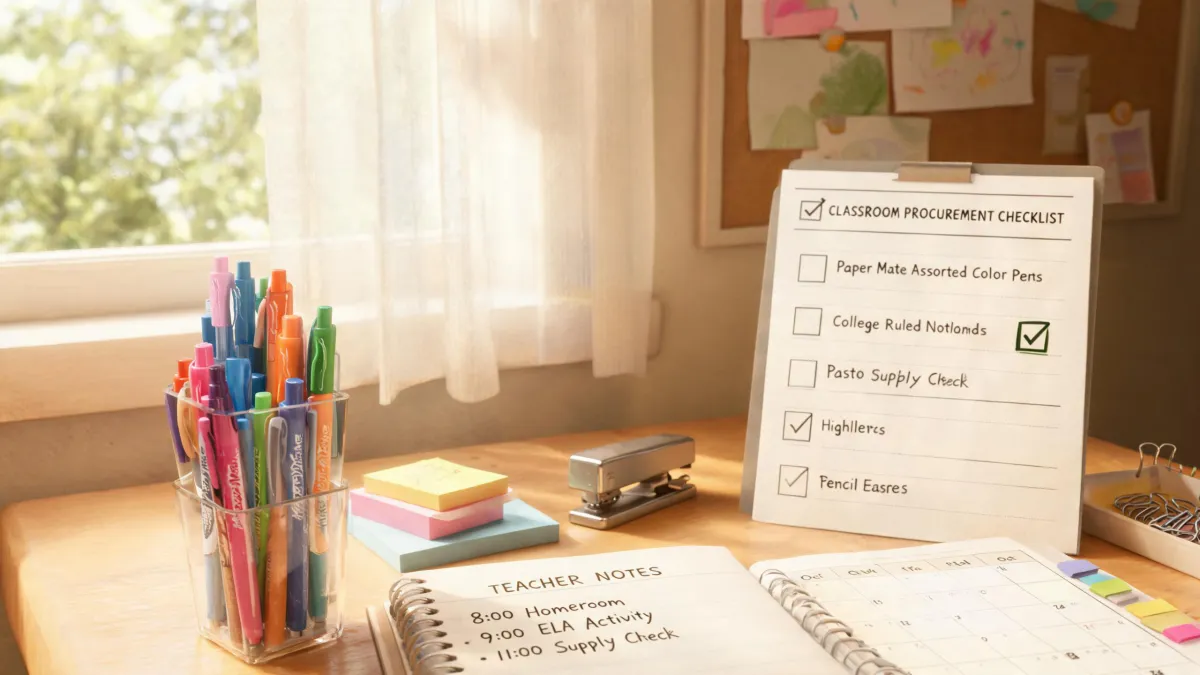
I have a strange job for a stationery nerd: I review office supply orders before they reach customers. Pens, paper, printer toner, all of it. It sounds boring. It is not.
I also have an unpopular opinion: the small orders matter more than the big ones.
Not in revenue, obviously. But in attention. A 10,000-unit corporate order has a dedicated manager, a contract review, a spec sheet. A 100-unit office order often arrives with hope and a purchase order. If something is wrong, the buyer notices. I notice because I check every box anyway. That is the whole point.
I Review Roughly 200+ Office Items a Year
Since 2022, I have worked as a quality and brand compliance reviewer for office products. My job is the boring kind of careful: make sure the item matches the description, the package matches the SKU, and the product does not fall apart in normal use. It sounds simple. It is not.
I review roughly 200+ unique items a year. I have rejected maybe 8% of first deliveries in 2024 for issues like smudged print, dried ink, or packaging that did not match the contents. Those were not dramatic failures. Most were correctable. But every one of them would have reached a customer if nobody had looked twice. That is why I take the small orders seriously. They are usually the ones nobody else is watching.
First Year, First Mistake
In my first year, I made the classic specification error: I assumed 'standard' meant the same thing to every vendor. It does not. We ordered 1,000 Paper Mate Erasermate pens for a small nonprofit. The order looked fine at a glance. Then a few users told me the erasers were tearing off when they used them. Actually, the first one came back with the eraser completely removed and a note that said 'this is not what standard means'. Fair point.
We checked the batch. The grip section on some pens was visibly misaligned. Normal tolerance, in my view, should have been almost invisible. The vendor called it 'within industry standard'. I called the order a waste of $600 and had it redone. That cost us the whole timeline. Now every contract I touch includes a visual sampling check. Smart spec, maybe; learned the hard way, definitely.
That was also the first time I understood why small-order quality reviews are not a favor. They are the backstop.
Why Small Orders Seem to Fail More
Small orders do not fail more because they are hard. They fail because nobody reviews them. When an order is 500 units rather than 50,000, there is a temptation to think it will take care of itself. That is a red flag.
During our Q1 2024 quality audit, I compared defect rates on orders under 1,000 units against orders over 10,000 units. The small orders had a higher rate of correctable errors: wrong packaging, missing SKU labels, and product descriptions that did not match the actual items. The big orders had more spec deviations but fewer downstream surprises. Why? Because somebody was watching them. Somebody always watches a big order. Small orders need a watcher too.
Does that mean every supplier needs to babysit a box of pens? No. It means the same standard should apply. If you order Paper Mate InkJoy Kilometrico pens for a team of 20, you deserve the same functional quality as a company ordering 20,000. You also deserve a straightforward answer if something changes.
Quality Checks Catch the Embarrassing Stuff
Most quality issues are not dramatic. In my experience, they fall into three groups:
- Packaging mismatches: the box says Paper Mate Erasermate pens, but the refills inside are different.
- Spec drift: the pen body feels right, but the clip bends more than it should.
- Ink behavior: gel pens skip, ballpoints drag, or markers bleed too much for the paper they were meant for.
None of these cause a recall. Each one causes annoyance. For a small office, annoyance is expensive. They do not have a warehouse of backups.
That is why I keep a sample from rejected batches. It is a habit that saves me from people who try to argue with 'trust your gut'. I do not need to argue. I have the sample.
Small Teams Need Tools That Do Not Create Homework
Small offices do not buy only pens. They buy Brother printers, HP scanners, and a pile of other tools that are basically promises. When the promise breaks, small teams do not have an IT manager to call. They search for how to scan from HP printer to computer and hope the instructions make sense. If you have ever done that, you know the instructions are often worse than the problem.
I have had the same experience with office product specs. A customer once asked me whether a Brother printer with a 250-sheet tray could handle a 400-page manual. The obvious answer is 'no', but the better answer is 'it depends on the job'. I did not just tell them what to buy. I helped them think through it. That is the service standard I care about.
Another client, a small bookkeeping practice, asked me about something completely outside stationery: they wanted to know if a no tax on overtime calculator was worth using. I am not a tax professional, so I told them to verify it with an accountant. But I respected the question. Why? Because it showed they were trying to make payroll decisions without a big finance team. They needed the same honest, useful answer they would get from a large corporate finance department.
These moments are why I keep coming back to the same point: small orders are not practice orders.
The Counterargument I Hear Constantly
The pushback is predictable: small orders have thin margins. They take time. Vendors cannot afford the same service level for a 100-unit purchase as for a 10,000-unit one.
Honestly, I get it. There is a real cost to personalized service. I have mixed feelings about minimums anyway. On one hand, they protect suppliers and make pricing manageable. On the other, they push small buyers into ordering too much or getting nothing.
Here is the thing though: the size of the order tells you about the product, not the person. Today's 100-unit customer might be next year's 10,000-unit customer. I have seen it happen. A founder who bought a handful of Erasermate pens and a Brother printer for a shared office eventually built a team that ordered supplies by the carton. The vendors who treated that founder seriously from day one were the ones who got the growth order.
Small doesn't mean unimportant. It means potential.
When I was starting out, the vendors who treated my $200 orders seriously are the ones I still use for $20,000 orders. The vendors who dismissed the small stuff taught me their limit. I do not test that limit twice.
What I Tell My Suppliers
My rule is simple: the size of the order should not change the quality of the answer. If a customer asks a question about Paper Mate InkJoy Kilometrico refills, answer like they are buying a year of them. If they need guidance on scanning from an HP printer to a computer, point them to the correct driver and walk through the first test.
Use the right amount of care, not the least possible. A short email is fine, as long as it does not dodge the customer. A one-line answer is fine if it is actually true.
That is why I think the industry's obsession with minimum order quantities misses the point. I am not saying minimums are wrong. I am saying they should not become an excuse to lower standards.
A Quick Note on Pricing
Public pricing reference, January 2025: a 12-pack of Paper Mate InkJoy gel pens listed between roughly $10 and $20 at major US office supply retailers. A basic Brother printer with scanning capability listed between roughly $100 and $200. These are not forecasts or quotes. Verify current rates before budgeting.
Office prices change fast. I would rather say 'check the current listing' than pretend my pricing knowledge never goes stale. That is not a dodge. It is the same honesty I would want from a supplier who tells me the ink formula changed.
Bottom Line
I have been doing this for over four years, and I still believe the quality check matters most when nobody else is looking. It matters on the $200 order. It matters on the 100-unit pen purchase. It matters when you search for help with a Brother printer or a no tax on overtime calculator and get a genuine explanation instead of a dead link.
The tools may change. The specs may change. The standard should not.
There is something satisfying about knowing the quality check happened before you had to call customer service. That is the standard I use. It is the one I teach. And if you are running a small office, I hope the people you buy from use it too.