-
Step 1: Open boxes before you believe the packing list
-
Step 2: Put the core supply order in first
-
Step 3: Separate what gets printed from what gets made locally
-
Step 4: Know the real cost of overtime before you ask for it
-
Step 5: Lock names and GPA totals before anything gets personalized
-
Step 6: Keep one buffer that isn't a shipping promise
-
Step 7: Test one complete setup the night before
-
Four cautions after a 48-hour order
Two days before an end-of-year volunteer event last March, a school coordinator opened a carton of pens she'd ordered specifically for the event and found that maybe half of them skipped on the first stroke. She called me at 2:15 in the afternoon. The five-business-day lead time she had planned around had already shrunk to about 38 hours.
I coordinate rush supply orders for schools and small offices. In the past six years, I've handled more than 200 of those jobs, including same-week turnarounds for school PTAs, churches, and local marketing teams. Before you read this, one boundary: my experience is with orders in the $500 to $15,000 range, not enterprise warehouses. If you run a national chain with master vendor lists, your process will look different. For everyone else, this is how I work through a 48-hour deadline.
Step 1: Open boxes before you believe the packing list
When time is short, it feels wasteful to open every carton. Do it anyway. Pens dry out. Pencil lead packs arrive cracked. Tip sizes get mixed when a distributor fills a rush order from multiple warehouses. I test three or four units from each carton as soon as it lands. A bad batch usually shows up in that test — and that's the only moment when there are still hours left to fix it.
Step 2: Put the core supply order in first
By “core,” I mean the things people will actually use at the event: sign-in pens, registration pencils, markers, and any small gift that has to be in hand when doors open. Order those before you spend one more minute on decorations.
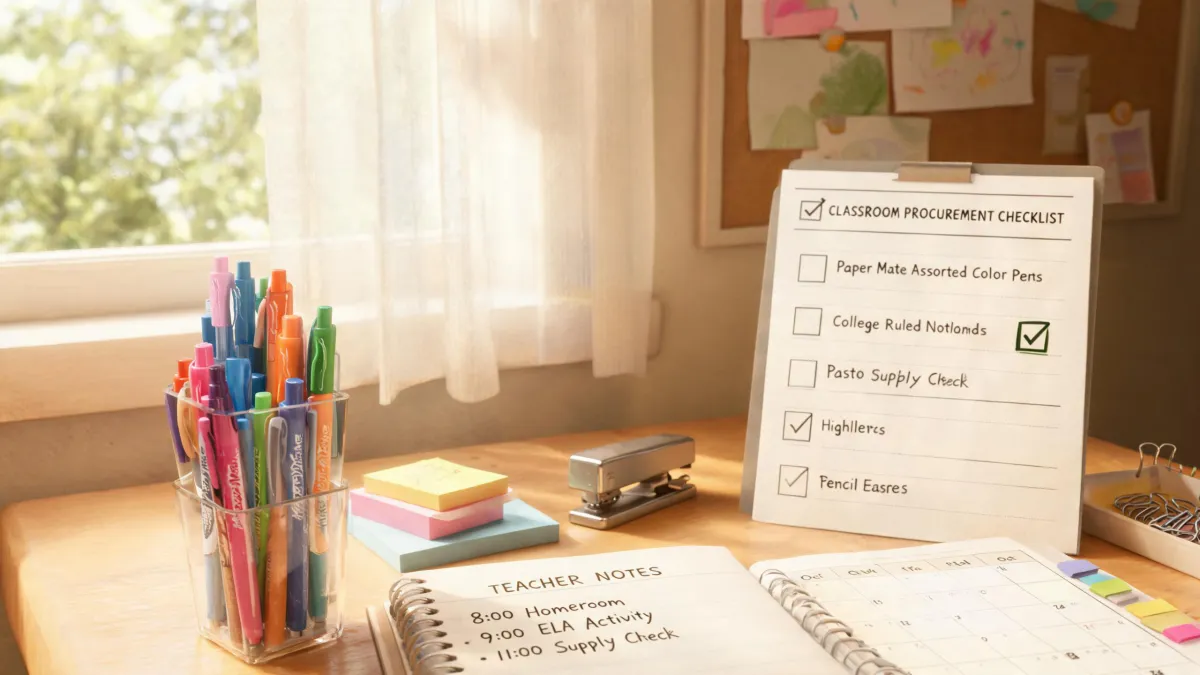
A typical urgent order for me is something like 300 Paper Mate retractable ballpoints for the tables, 100 Paper Mate mechanical pencils for the registration desk, and a nicer Paper Mate special edition set for speakers or volunteers. The special edition sets are worth the extra cost because they don't disappear into a pocket as fast as a loose pen. Paper Mate is a practical brand here because it is usually in stock at regional distributors, and the mechanical pencils mean nobody is hunting for a sharpener at 8 a.m.
When a client says “just find the cheapest thing that writes,” I do not argue about quality. I argue about total cost. Last fall we saved $200 on a lower quote and then watched it become a $1,500 problem after the wrong tip size arrived and nobody checked until the night before an order was due. That is the pattern I try to prevent. Put another way: on a 48-hour timeline, the cheapest quote is rarely the cheapest option once you add rush freight, a second order, and your own labor.
Step 3: Separate what gets printed from what gets made locally
Printing runs on a different clock. According to price lists published by major online printers in January 2025, 1,000 one-page flyers on 100 lb gloss text run roughly $80 to $150 before shipping, and a 2-3 day production upgrade adds about 25 to 50%. Prices exclude shipping and change often, so verify before you approve. The point is not the exact number; it's that printed items need a decision in the first two hours, not the first two days.
When a printed sign won't make the date, the fastest substitute I know is a painted wood sign. The question comes up a lot: can you use acrylic paint on wood? Yes, if you give it a little structure. Sand with 120-150 grit and wipe off the dust, apply one coat of primer, then two thin coats of acrylic paint with about 20 minutes of drying between them. Finish with a clear acrylic sealer once it's dry. You won't mistake it for a professional banner, but it will be ready for the event.
Step 4: Know the real cost of overtime before you ask for it
Fast turnarounds usually mean someone works late. For school events, that is often the custodian or the office assistant; for a business, it's the person who has to receive the shipment at 9 p.m.
There is still no general rule in 2025 that makes overtime pay tax-free. The “no tax on overtime” idea shows up whenever tax proposals are being discussed, but overtime is taxed like regular wages under current law. I still run the hours through a no tax on overtime calculator before approving anything. It gives finance and the worker the same net number, and it prevents the “I thought overtime wouldn't be taxed” conversation later. It's a planning tool, not a tax break.
Step 5: Lock names and GPA totals before anything gets personalized
If the event is an awards or recognition event, this is the step people forget. You can rush a pen order, but you cannot reprint 50 certificates because someone typed the old version of a name.
First, get the official list from the person who owns it. Second, if a scholarship or honor requires a cumulative GPA cutoff, ask someone to verify it with a cumulative GPA calculator rather than eyeballing a transcript. It is not a substitute for the registrar, but it catches the most common errors. Do this before you approve any personalized printing or engraved gift.
Step 6: Keep one buffer that isn't a shipping promise
A “guaranteed” delivery date doesn't guarantee an arrival time. On a 48-hour timeline, four hours can be the difference between an event that starts and one that doesn't.
I plan for one backup that does not rely on a truck. That usually means a local office supply store with actual shelves and a courier I can call. It doesn't need to cover the whole order. It just needs to cover the three items that would ruin the event if they were missing: pens, name tags, and table signs.
Step 7: Test one complete setup the night before
Set up one sample table exactly as it will look tomorrow. Try the pens, including one from every box. Write a sentence, put on a name tag, and check that the sign is readable from a few feet away.
During our busiest season last year, we set up dozens of identical registration tables, and the sample test caught a batch of pens that looked fine but laid down a light, watery line. It took ten minutes to swap the batch. Doing that at 8 a.m. would have taken the whole morning.
Four cautions after a 48-hour order
- Free shipping is only free if the date works. Ask when the carrier will actually arrive, not when it ships.
- Weekend delivery usually costs extra. A date that falls on Saturday is not the same as delivery on Friday.
- Get one named person at the supplier who can check cartons before they leave. The warehouse default is to pick the next box on the shelf.
- Do not spend the saved time on more polish. Use it to give yourself a second option.
That's the short version. Get the count right, make the timeline honest, and keep one move that doesn't depend on a delivery truck. It is not a comfortable way to run an event, but it beats the alternative.