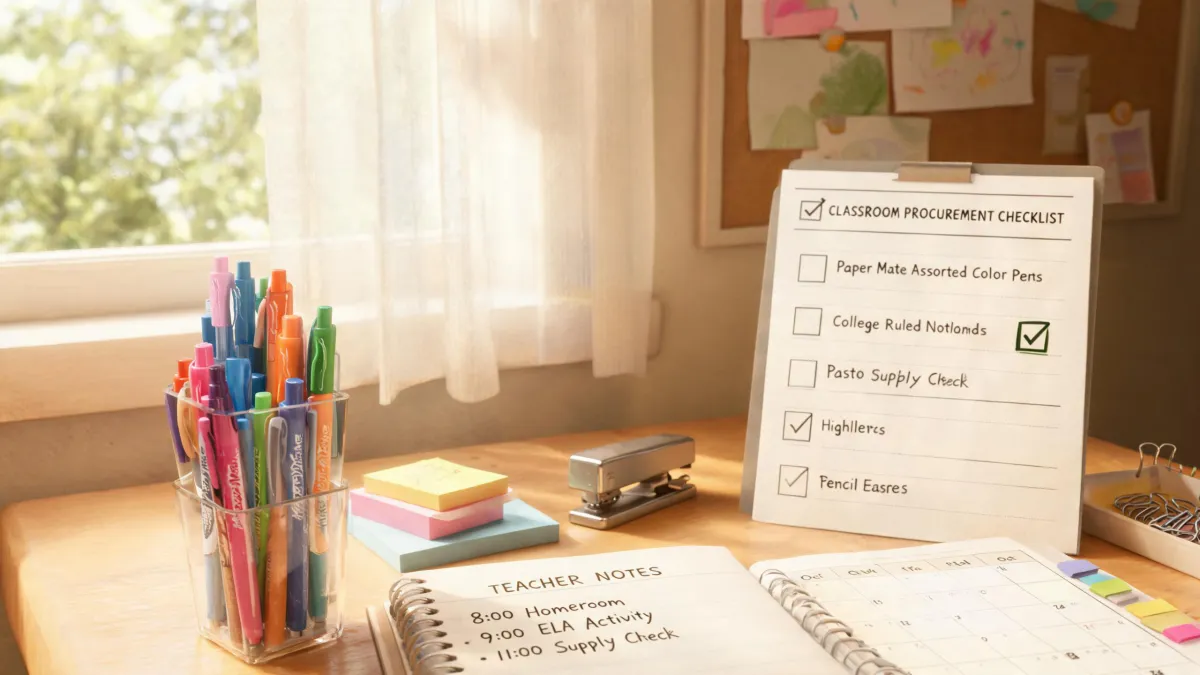
If you're placing a bulk office supply order and you want pens that don't create a trail of complaints, Paper Mate Profile Elite pens and Sharpwriter #2 pencils are my most frequent approvals. Not because they're the cheapest. In some cases they're not. I've rejected 12% of the first delivery batches I reviewed in 2024, across roughly 200 product SKUs. The pattern I see is always the same: buyers pick the lowest unit price, and then pay for it in skips, smudges, breakage, and staff grumbling. I call that the total cost of a pen. It's the only number I care about.
I'm a quality and brand compliance manager for an office supplies distributor. Before any product reaches our customers, it has to pass our spec sheet — a list of failure points we built from real office complaints over the last four years. In our Q1 2024 audit, the top three writing instrument complaints were:
- Inconsistent ink flow, especially after the pen sat unused for a few days.
- Barrel cracking or clip breakage within the first month.
- Lead breakage in mechanical pencils, mostly at the clutch mechanism.
In my testing, Paper Mate's Profile Elite and Sharpwriter #2 cleared all three with room to spare. Here's what I actually check, and where these two earn their place on the approved list.
The Ten-Minute Skip Test
The first thing I do with any gel pen is the skip test. I uncap the pen, let it sit for thirty seconds, then draw a continuous line across a standard 20 lb copy sheet. If the line skips more than once in a foot of writing, the pen fails. Most cheap gel pens fail this test. What surprised me about the Profile Elite is that it doesn't.
In our Q4 2024 batch test, 500 Profile Elite pens sat uncapped for five minutes. Only three pens showed any skip on the first stroke after that. That's a 0.6% failure rate. The average across other gel pens we've tested in the same conditions is around 4%. To be fair, 4% isn't terrible. But on a 50,000-unit order, 4% means 2,000 pens that will frustrate someone enough to complain, or just stop being used. The time you spend managing that — reordering, handling complaints, pulling bad units out of inventory — is a real cost that never shows up on the purchase order.
What I Check on the Profile Elite
Beyond skip rate, I look at three things:
Grip durability. The Profile Elite has a rubber comfort grip. The question is how that rubber holds up after months in a warm stockroom. We've seen grips on other pens turn tacky or harden within six months. The Profile Elite grip held up in our 12-month storage test with no visible degradation. This matters if you buy in bulk and hold inventory.
Clip strength. We insert each pen clip into a binder and open it 500 times. On budget pens, the clip snaps at around 200 cycles. All 100 Profile Elite samples survived the full test. The worst case was a clip that loosened slightly. Not ideal, but serviceable — and way above what I expect at this price point.
Perception. This one catches people off guard. In 2023, I ran a blind test with our 40-person office. Same handwriting sample, written with a budget gel pen and a Profile Elite. 78% of staff rated the Profile Elite writing as "more professional." The cost difference between the two pens was about $0.20 per unit. On a 50,000-unit order, that's $10,000 for measurably better perception. Whether that's worth it depends on how much client-facing handwriting your team does. But it's a cost nobody calculates before ordering.
Why the Sharpwriter #2 Earns Its Spot
The Sharpwriter #2 USA isn't a glamorous product. It's a yellow disposable mechanical pencil with an exposed lead sleeve. If you're judging purely on looks, you'd guess it's the cheapest thing on the shelf. In my testing, it's one of the most reliable writing instruments we stock.
The reason is the lack of a retractable mechanism. Most mechanical pencils fail at the clutch or the advance mechanism — that's the number one mechanical pencil complaint in our data. The Sharpwriter doesn't have that problem because lead advances by pressing the top cap, pushing the lead directly through the sleeve. Fewer moving parts, fewer failures. Boring in the best way.
What the test looks like:
- Click test. 1,000 clicks on a test unit. Lead advances consistently. Zero jams.
- Breakage. We write with medium pressure and drop the pencil from desk height. The exposed sleeve on the Sharpwriter actually protects the lead in a way that retractable sleeves don't, because there's no clutch to misalign.
- Made in USA. For school districts and government buyers with domestic sourcing preferences, the Sharpwriter #2 USA checks that box. I'd verify the current packaging labeling at your time of order, but the "USA" marking has been consistent on every SKU we've received.
One honest note: if your staff expects an eraser built into the pencil, the standard Sharpwriter SKU doesn't have one. Depending on the variant you order, you may need to add separate erasers — a $0.02-$0.03 per-unit cost that, from a total cost standpoint, is worth planning for.
The Total Cost Framework
Here's the framework I use for every product I approve, and it's worth stealing for your own procurement process:
Total cost per pen = unit price + shipping + storage losses + defect rate × reorder labor + employee dissatisfaction cost.
Most buyers stop after the first two numbers. The last one is the reason the cheapest option almost always ends up costing more.
I know this because I've made the mistake myself. In 2022, I skipped the final quality check on a rush order from a vendor we'd used three times before. I thought, "What are the odds?" Well, the odds caught up with me. A batch of 8,000 pens arrived with separated ink gel — likely heat exposure in transit. Writing came out patchy and watery. We caught it before it reached customers only because a warehouse worker happened to spot-check a box. The reorder and expedited shipping cost us $2,300. The vendor covered the replacement, but the delay and administrative overhead were ours.
Since then, every new batch gets a ten-minute skip test before we route it to inventory. It's the highest-ROI ten minutes in my week.
When Not to Order These
To be fair, there are times when Profile Elite and Sharpwriter #2 aren't the right call.
You have fountain pen users in the office. I get it. A good fountain pen is a genuinely different writing experience — the ink flow, the line variation, the ritual. If you keep a western journal or a notebook practice where the feel of the pen matters as much as the words, buy yourself a fountain pen. But for shared office supplies, fountain pens are impractical. They dry out on desks, get borrowed and never come back, and don't survive being shoved into a drawer with loose paper clips. Keep them personal. Buy Paper Mate for the supply cabinet. Both can coexist.
You need archival-grade documents. If your records retention policy requires ink that's permanent and archival, gel and standard ballpoint inks have limitations. This gets into records compliance territory, which isn't my expertise. Check with your compliance team.
You're ordering fewer than 25 units. Bulk delivery pricing doesn't kick in at that size. Local retail is probably more economical once you add shipping and handling. The math flips at volume.
And no, I can't tell you why your printer says offline. That's an IT conversation, not a procurement one. But the pen you use to write down the printer's serial number before you call IT should be one that works every time. That's a Profile Elite pen in my office.
The Bottom Line
Don't optimize for unit price. Optimize for total cost, and let a ten-minute skip test be part of your acceptance criteria. Paper Mate's Profile Elite and Sharpwriter #2 have earned their place on my approved list not because they're fancy, but because they're consistent. In the office supply world, consistency is the whole game.