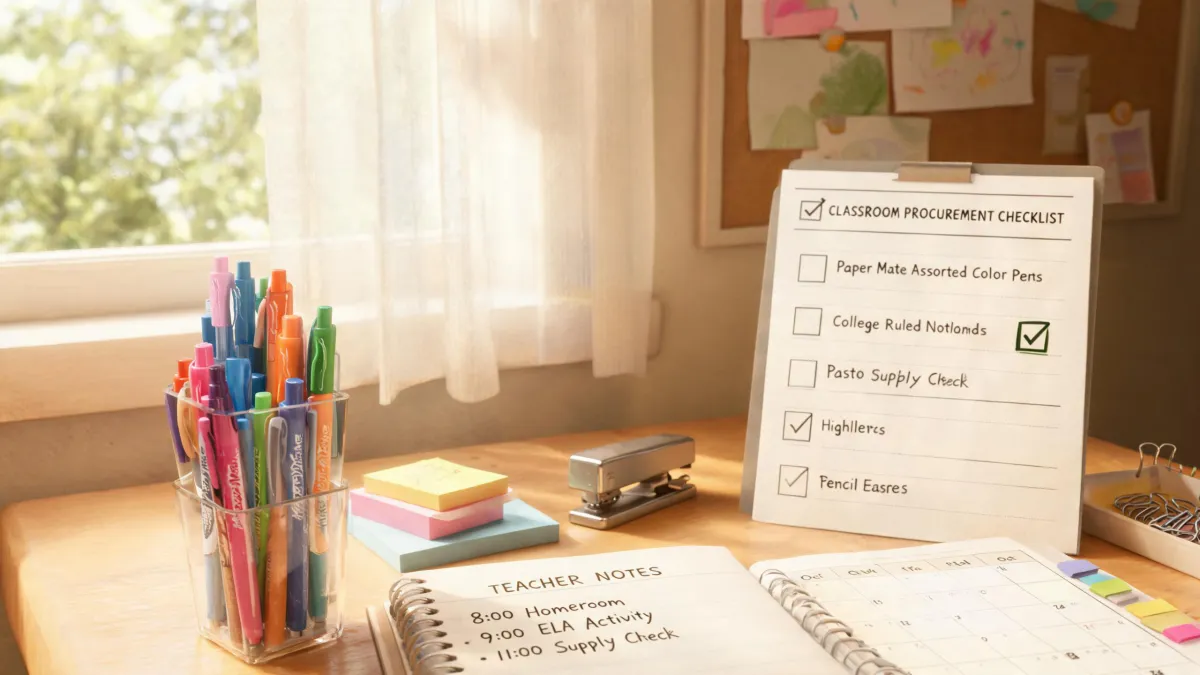
I've been handling office supply orders for five years now. I've personally made (and documented) four significant purchasing mistakes, totaling roughly $4,500 in wasted budget. Now I maintain our team's procurement checklist, and I'm going to share the mistake that taught me the most.
It happened in my first year, and it's the classic rookie error: I assumed a pen is a pen, so buying the cheapest ones in bulk was obviously the smartest move. Our company standardizes on paper-mate products, but at that point I hadn't really learned which paper-mate products mattered and which ones just filled a shelf.
The result was predictable. I ordered 1,000 pens—mixed ballpoints, gels, and a few bold-tip models—and roughly 800 of them never left the supply closet. The bins sat there, untouched, for months. Meanwhile, my colleagues kept asking, "Do we have any pens that actually work?"
That contradiction—a fully stocked supply closet and zero usable pens—is the puzzle I want to unpack here. If you manage an office, an admin team, or even just a shared kitchen drawer, you've probably seen the same thing. The problem is never what it looks like at first glance.
The Surface Problem: "There Are No Pens"
Someone tells you we're out of pens. You check the supply room. Four hundred pens are sitting there in unopened boxes. Yet people are still complaining.
So what's actually going on? It's not inventory count. It's fit—the match between the pen and the job.
Office pens are not one product category. A Paper Mate Profile Ball 1.4 blue is a bold, smooth, deliberate pen. It's built for signatures, approvals, anything where the writing itself should carry weight. But write two pages of notes with it and you'll feel it—that 1.4mm tip is wide, and it tires your hand quickly.
A Paper Mate Flair tip pen, on the other hand, is a felt-tip with a fluid, expressive line. It's made for color-coding, annotating documents, and margin notes. It's water-based ink, so if you leave the cap off, it dries out by the next morning.
And then there's the standard everyday ballpoint—the workhorse for filling forms and jotting quick notes.
Hand every employee the same pen and expect them to be happy? You've mismatched the tool to the task. That's the surface issue.
The Deep Causes Nobody Talks About
1. Pens don't disappear because they're cheap. They disappear because they're good.
Here's the idea that completely changed how I buy supplies: people use the pens that work, and they keep using them.
A pen that writes smoothly, sits well in the hand, and gets the job done is going to end up in someone's drawer or bag—permanently. A pen that skips, scratches, or feels like a stick is going to be abandoned in the community bin forever.
So when someone says, "Why do pens keep disappearing?"—that's the wrong question. The right question is: which pens are disappearing?
The surprise wasn't the disappearance. It was the pattern. The pens that vanished were the ones people actually liked. The pens that stayed were the ones nobody wanted. I'd been buying the wrong pens to save pennies, and the whole office paid for it in quiet frustration.
2. Bulk buying hides the waste
There's a satisfying feeling when you see a per-unit price of $0.18 and think you've beaten the system. But here's the number I wasn't tracking: a 500-pack at $90 where only 20% gets used is $72 of pure waste, not savings.
A factoring calculator can tell you that 500 × $0.18 = $90. It can't tell you what portion of those pens will ever get picked up. The only formula that matters is pens used ÷ pens purchased—and I didn't have enough data to know that number.
For what it's worth, you don't need a tip calculator to figure this out. It's just: total spend divided by units actually used. Some of our pens ended up costing over $1.50 per use. Ouch.
3. Nobody asked the team what they wanted
In my first year, I didn't run a single survey, poll, or pilot. I just… ordered. That's how we ended up with 300 mixed gel pens that the office collectively ignored, and 500 bold-tip Profile pens—450 sitting in the closet because the bulk discount felt too good to pass up (note to self: it's not a deal if it sits unused).
We didn't have a formal needs-assessment process. The third time the Flair pens ran out, I finally built a simple request tracker with a two-week usage check. I really should have done it after the first time.
The Real Cost of Getting It Wrong
Direct costs first. By the end of my first fiscal year, I'd spent roughly $1,200 on pens that were essentially dead inventory. That's the line item that gets noticed in a budget review—"why did we spend this?"—and I had to answer that question more than once.
The indirect cost was worse. Every week, several people emailed or slacked me, "Do we have any pens that actually work?" (ugh, the same question, every single week). Each inquiry is a tiny interruption, but multiply it across a 120-person office and the friction adds up fast. You don't feel it as one event; you feel it as a slow drain on everyone's attention.
And then there's the credibility cost. Once you've made a visible procurement mistake, your judgment on future purchases gets questioned. That was the most painful part—and the most educational.
By Q1 2022, we finally cleared out the supply closet and counted 478 unused pens, mostly the cheap ballpoints and the hoarded bold-tip models. That count is what pushed me to build the system below.
What Fixed It (It Wasn't a Bigger Budget)
The solution cost nothing. It just required a routine and a little humility.
- Test before you scale. Order a small batch of candidate pens—five or six models max—and leave them in a shared area for a week. The ones that get used are the ones you buy in bulk. The ones that stay are the ones you skip.
- Ask instead of assuming. A quick Slack poll is free. "If you could only have one pen for a week, which would you choose?" The answers are surprisingly decisive. For us, the team split between Paper Mate Flair tip pens for annotation and color-coding, the Paper Mate Profile Ball 1.4 blue for signing and high-visibility writing, and a basic ballpoint for everyday forms.
- Standardize on two or three SKUs. No more "variety packs." No more random assortment. Pick a short list, stick to it, reorder the same things automatically.
- Show the math. I shared the unit costs and reasoning with the team—publicly. When people saw that a Flair costs $0.60 but gets used twice as much as a $0.20 alternative, the complaints stopped. The conversation shifted from "we need pens" to "which pens are the right ones?"
Since we put this checklist in place, we've caught 47 potential waste orders in the past 18 months. The transparency principle applies to vendors too: a supplier who lists all costs upfront—including shipping and handling—is more trustworthy than one who shows a low base price and tacks on fees later.
One side note: the "right tool for the right surface" idea applies beyond pens. People sometimes ask me, "Can you use acrylic paint on fabric?" Technically yes, but it's not the same as writing ink—it cracks, it stiffens, and it won't hold fine detail without a fabric medium. Fabric markers exist for a reason. Same logic, different aisle.
The Bottom Line
I could tell you not to make the same mistake I did, but that's a little too tidy. The truth is, most of us buy for price instead of fit at some point. The only question is how much the lesson costs you.
Mine cost about $1,200 and a year of answering embarrassing emails. (Thankfully, we've recovered, and our supply closet is now stocked with pens people actually use.)
Buy pens because your team will use them—not because the unit price is low. Test small. Ask real questions. And if a vendor won't show the full price upfront, that's a red flag. The quote that's transparent from the start is, in my experience, the one you can actually trust.
Now, if you'll excuse me, I have a supply order to review. This time I'm not just checking the price per unit. I'm checking the usage per bin.