The Surface Problem: You Think You Need a Cheaper Pen
Let's start with something straightforward. If you manage office supplies for a team of 50 or 500, you've probably run this calculation in your head: 'We're spending too much on pens and pencils. Let's just buy the cheapest bulk option.'
It makes sense. On paper. But I've seen this logic backfire more times than I can count.
In my first year as a quality compliance manager, I approved a bulk order of 2,000 pens from a vendor I'd never vetted. The per-unit cost was unbeatable. Sixty days later, I was dealing with complaints about skipping ink, broken clips, and a desk drawer full of unusable sticks. The vendor blamed 'storage conditions.' I blamed my lack of a real spec sheet.
That mistake cost us roughly $600 in re-order fees and lost employee time. Not catastrophic, but completely avoidable.
From the outside, it looks like you just need to find a cheaper supplier. The reality is that 'cheap' often means inconsistent—and inconsistency is the enemy of a professional office environment.
What Most Buyers Miss
Most buyers focus on per-unit pricing and completely miss the hidden costs of variability. When you order 1,000 mechanical pencils, you're not buying 1,000 identical items. You're buying 1,000 opportunities for something to go wrong—and the less you pay per unit, the more those opportunities tend to manifest.
People assume the lowest quote means the vendor is more efficient. What they don't see is which quality corners are being cut to get there.
The Deeper Problem: It's Not About the Pen—It's About Consistency
Here's where the conversation gets interesting. The real issue isn't whether you can find a cheaper pen. It's whether you can trust that every pen in that box meets a consistent standard.
I ran a blind test with my team last year. Same type of mechanical pencil—one batch from a discount bulk supplier, one from a known brand (Paper Mate Clearpoint). I asked 12 people to use each for a week and report back.
Every single person identified the Paper Mate as 'smoother' or 'more reliable.' The cost difference? About $0.15 per unit on a bulk order. On a run of 500 pencils, that's $75 for measurably better perception among your employees.
Most people focus on the unit price. The question they should ask is: What is the cost of a bad experience?
When an employee picks up a mechanical pencil and the lead snaps twice in five minutes, or the eraser leaves a smear, they don't think 'cheap pencil.' They think 'cheap office.' That impression spreads.
The Hidden Cost of Inconsistency
In our Q1 2024 quality audit, we tracked returns and complaints on office supplies across five departments. The data was clear: products with more than a 5% defect rate generated disproportionately more negative feedback—not just about the product, but about the company's commitment to quality.
- Direct costs: Replacement orders, restocking fees, wasted time processing returns.
- Indirect costs: Lower employee satisfaction, less professional client-facing materials, increased administrative burden.
The math is simple: a 10% defect rate on a $0.20 pencil doesn't save you money—it costs you trust.
The Real Cost of 'Good Enough'
I get why people go with the cheapest option—budgets are real. I've been in meetings where finance says 'we need to trim supply costs by 15%.' The natural impulse is to cut prices per item.
But that approach ignores something critical: the total cost of using a product.
Let's take a specific example. Paper Mate Clearpoint mechanical pencils come in 0.5mm, 0.7mm, and 0.9mm lead sizes. They have a retractable tip, a comfortable grip, and a consistent eraser. If you buy those, your employees can focus on writing, not on fighting their tools.
If you buy a no-name alternative with a 15% breakage rate on the sleeve or a flimsy clip that snaps after a week, you've saved maybe $0.10 per pencil. But now you've introduced friction into someone's workday. That friction adds up.
5 minutes of verification beats 5 days of correction.
In my experience, the companies that get this right are the ones that treat office supplies like any other business tool: they measure the total cost, not just the purchase price.
A Spoiler: We Switched to Clearpoint
After that audit and the blind test, we standardized on Paper Mate Clearpoint for our mechanical pencils. The initial cost was slightly higher, but we cut our complaint tickets related to writing instruments by roughly 40% over the next six months.
Was it the perfect solution? No. But it was a reliable one.
The Practical Fix: Three Things to Check Before Your Next Bulk Order
If you're managing office supplies, here's where I'd focus your energy. The solution isn't complicated, but it does require a shift in mindset.
- Specify, don't generalize. Instead of ordering 'mechanical pencils,' order '0.7mm mechanical pencil, retractable tip, click advance, 12-pack bulk.' The more specific you are, the more consistent the delivery.
- Test a sample batch. Before committing to 500 units, order 12. Give them to your most critical writers—the person who edits reports, the one who fills out forms all day. Get real feedback. It's cheap insurance.
- Track returns and complaints. If you don't measure the hidden costs, you'll never know if your 'cheap' decision is actually costing you more. A simple spreadsheet can reveal patterns you'd otherwise miss.
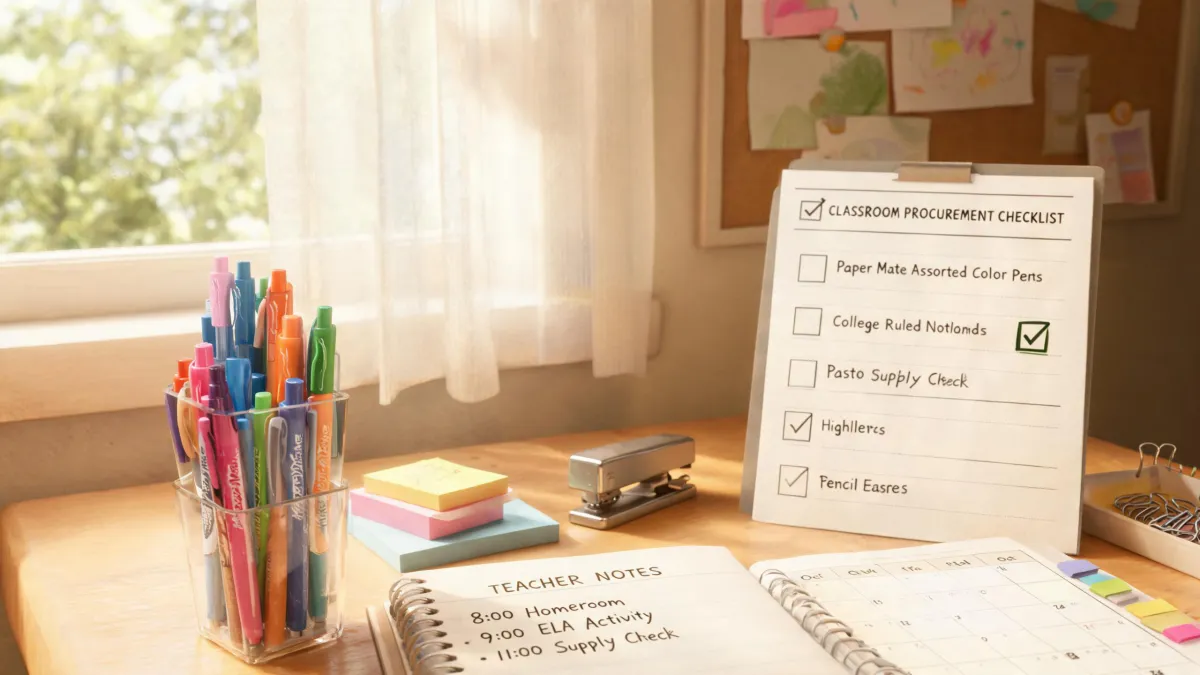
The checklist I created after my first year in quality has saved us an estimated $8,000 in potential rework across all categories—not just pens. That's the power of a little upfront diligence.
Look, I'm not saying every office needs to buy premium brands across the board. But I am saying that 'cheapest' is rarely 'cheapest' in the long run. And when you find a product line that delivers consistent quality—like the Paper Mate Clearpoint—the small premium is almost always worth it.
Paper Mate itself has a surprisingly good website for comparing their product lines. They're transparent about specs. That's a green flag for any B2B buyer.