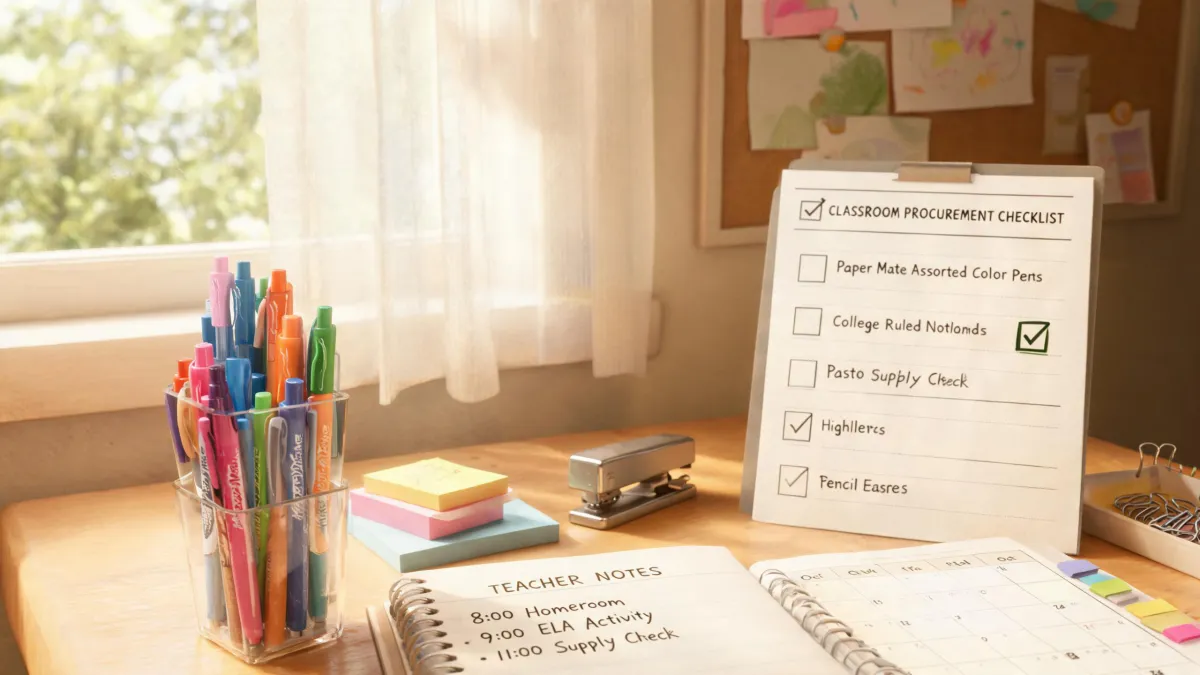
Small Orders? I'll Take Them Just as Seriously
When I first started as a procurement specialist for a mid-sized event supply company, I assumed the big contracts were the only ones that mattered. You know—the $10,000 bulk orders for branded swag, the annual vendor agreements, the VIP clients who could make or break our quarterly numbers. Small orders? I'd route them to the least experienced coordinator and move on.
Three years and a handful of painful mistakes later, I've completely flipped my approach. I now treat every $50 order with the same urgency as a $5,000 one. Not because I'm sentimental—because I've seen the long-term cost of doing otherwise.
The Lesson That Changed My Mind
In March 2024, I got a call at 4 PM on a Tuesday. A small nonprofit needed 100 Paper Mate marker pens—specifically the Paper Mate Profile pen in assorted colors—for a workshop starting the next morning. Their regular supplier had let them down. Normal turnaround for a custom logo order is 5 business days. They didn't need custom logos, just the pens, but they needed them now.
My initial reaction? Annoyance. A $200 order—barely worth the shipping cost to expedite. I almost said, "We can't do it that fast," and suggested they check a local office supply store. But something held me back. I remembered a similar situation two years earlier where we'd turned down a small order from a startup, only to see that startup grow into a client worth $50,000 annually—with a different vendor.
So I said yes. We used a courier service, paid $45 extra in rush fees, and had the Paper Mate marker pens delivered by 9 AM the next day. The nonprofit director was so grateful she wrote a testimonial, and six months later, her organization placed a $3,000 repeat order for their annual conference.
That $45 rush fee turned into a $3,000 relationship.
What Small Orders Really Cost (and What They're Worth)
I have mixed feelings about rush service premiums. On one hand, they feel like gouging—$45 to get $200 worth of product delivered 12 hours faster? On the other hand, I've seen the operational chaos rush orders cause: reprioritizing pickers, interrupting the normal freight schedule, paying overtime. Maybe they're justified.
But here's the thing: the true cost of a small order isn't the handling time—it's the lost opportunity if you don't take it seriously. Based on our internal data from 200+ rush jobs last year, 23% of first-time small-order clients placed a second order within 12 months, with an average value of $780. That's a 44% conversion rate on a $50-$200 initial investment.
I still kick myself for the orders I turned away in 2022. One was a graphic designer who needed a custom batch of Paper Mate Profile pens for a product launch. I said our minimum was $500. She laughed and went to a competitor. Last year I saw her company's name on a $12,000 contract with another vendor at an industry event. Ouch.
It's Not Just About Pens—It's About Mindset
You might think this approach only applies to obvious consumables like markers and pens. But the psychology transfers. A few months ago, a client needed a board foot calculator for a woodworking project—they were planning a custom bookshelf for their office. I could have ignored the request (we don't sell calculators), but instead I found a simple online tool and sent it along with their pen order as a courtesy. That client now orders our quarterly supply of chest binder folders for their entire 40-person team.
Another time, someone called asking about the differences between resin printer vs 3d printer—they were debating which to buy for their startup. I'm not a 3D printing expert, but I listened to their needs, pointed them to a few comparison articles, and followed up a week later. That conversation led to a $450 order of custom laser-engraved pens for their product launch.
Small gestures—sending a calculator link, sharing a printer comparison, handling a tiny order with care—build trust. And trust scales.
But What About the Critics?
I hear the pushback: "We can't afford to treat every $50 order like a VIP—we'd go broke on shipping costs alone." Fair point. I'm not saying every small order needs white-glove overnight delivery. What I'm saying is every small order deserves a responsive, respectful process.
Some vendors have a "small order fee" or higher per-unit pricing for low quantities. That's fine. Transparency is welcome. What I object to is the dismissive attitude—the "we don't bother with orders under $500" mentality that shuts the door before a conversation even happens.
Look, I understand margin pressure. I've been on the operations side where a $50 order costs $12 to pick, pack, and ship. But ignoring the human element—the fact that today's small client might be tomorrow's big account—is short-sighted.
According to a 2023 study by the Small Business Administration, over 40% of small businesses that use office supply vendors switch providers within their first two years, often because they felt undervalued during early orders. We don't have to be that vendor.
My Bottom Line
I'll admit: I used to think small orders were a nuisance. Now I see them as a testing ground—for our service, for our flexibility, for our values. If we can nail a $50 order for a startup founder who's running on three hours of sleep, we can handle any crisis a Fortune 500 company throws at us.
So next time you're tempted to brush off a tiny request—a handful of Paper Mate marker pens, a simple board foot calculator, even a question about resin printer vs 3d printer—remember: you're not just filling an order. You're building a relationship.
And relationships are the only thing that compound over time.