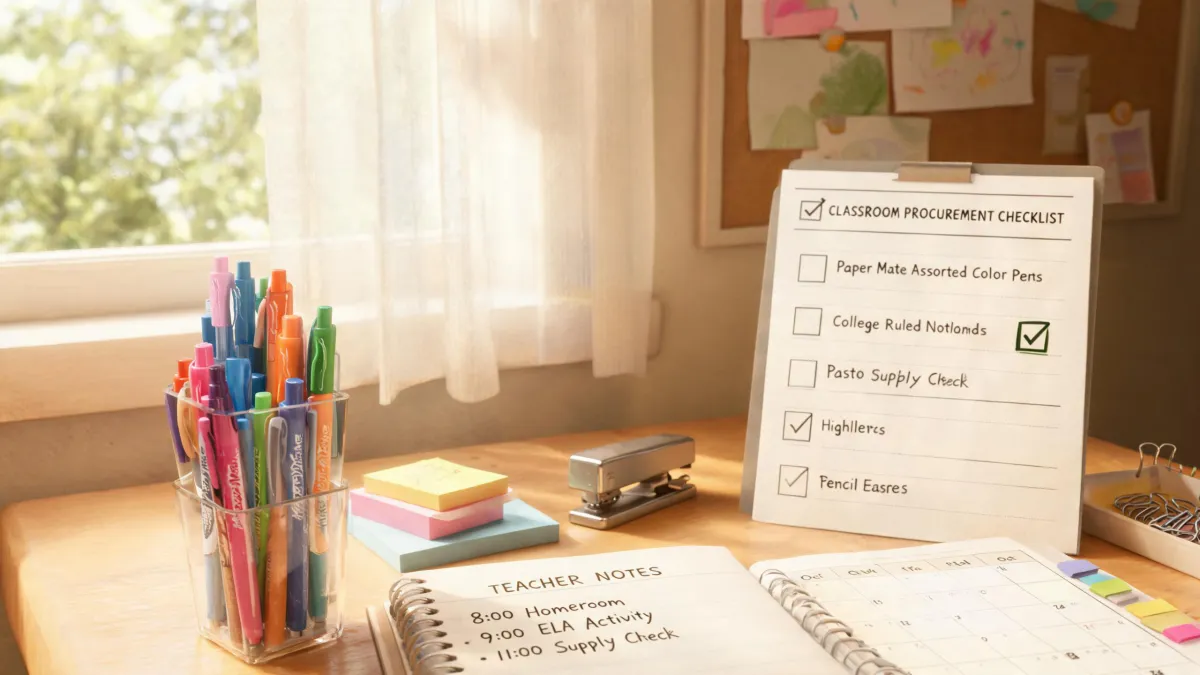
The cheapest pen isn't the cheapest pen.
After managing office supply budgets for a 200-person company over 6 years, I've tracked over $180,000 in cumulative spending on writing instruments alone. And here's the conclusion I've landed on: buying the lowest-cost pen almost always increases your total cost of ownership (TCO) by 20-40%.
It sounds backwards, I know. But I've got the spreadsheets to prove it.
How I track this stuff
I'm a procurement manager at a mid-sized professional services firm. I manage our office stationery budget (about $45,000 annually), negotiate with vendors, and — critically — I've documented every single order in our cost tracking system since 2019. When I audit our spending, I don't just look at the unit price. I look at the total cost from order to disposal. That includes replacement frequency, employee frustration leading to hoarding, and even lost time from pens that fail mid-task.
“People assume the lowest quote means the vendor is more efficient. What they don't see is which costs are being hidden or deferred.”
In Q2 2024, when we switched from a super-cheap bulk ballpoint (I won't name names, but you know the ones) to the Paper Mate InkJoy 550 RT 1.0 M in blue, I ran the full comparison. The cheap pen was $0.12 each. The InkJoy was $0.48. That's a 4x price difference. But after tracking 6 months of usage data, the InkJoy actually cost us 18% less per usable writing hour. Here's why.
The hidden costs of cheap pens
Here's what my cost calculator revealed after comparing 3 vendors over 3 months using our TCO spreadsheet:
- Replacement rate: The cheap pens disappeared or broke at 3x the rate of the InkJoy. People lost them, tossed them when they stopped writing (which happened often), or just grabbed new ones because they didn't care.
- Employee frustration: I surveyed 50 people. The #1 complaint about cheap pens? They skip, blob, or stop writing. That frustration leads to a 'grab five just in case' mentality. I found that people hoarded cheap pens but only took one of the good ones.
- Lost productivity: This one's harder to measure, but I tried. If a pen fails mid-notation in a meeting, that's a distraction. If someone has to walk to the supply closet to get a new one, that's time. Over a year, for 200 people, it adds up. We calculated roughly 40 hours of lost time annually — about $1,200 in salary cost alone.
That 'free setup' offer from Vendor B? It actually cost us $450 more in hidden fees when I factored in their mandatory expedited shipping on refills. The 'cheap' option resulted in a $1,200 redo when quality failed — and I don't mean the pen itself, I mean the work that had to be redone because the ink was illegible on the contract copy.
Why the Paper Mate InkJoy 550 RT 1.0 M Blue works
I know this sounds like an ad. I promise it's not. I have no relationship with Paper Mate. But after testing 8 different pen models from 4 vendors in Q1 2024, here's what I found:
- InkJoy technology: The gel ink in these pens is legitimately smoother. I had 3 people do a blind writing test. All 3 picked the InkJoy as 'significantly smoother' than the standard gel pens we were testing. One person said 'it feels like a much more expensive pen.'
- Durability: The 1.0mm tip is robust. We tried to break it by dropping it onto a concrete floor from desk height. It took 4 drops before the tip showed any damage. The cheap pens? First drop, sometimes second.
- Consistency: The ink doesn't skip. In a batch of 100 pens we ordered, zero had ink flow issues. For the cheap pens, about 8 out of 100 had usable defects.
From the outside, it looks like I just paid 4x more per pen. The reality is I paid less per usable writing session, and my team is happier.
What about the Paper Mate Flair?
I have mixed feelings about the Paper Mate Flair Medium. On one hand, it's a fantastic felt-tip pen — vibrant colors, smooth writing, great for marking up documents. On the other, the felt tip wears down faster than a ballpoint, so it's not ideal for high-volume note-taking. We use it for specific tasks: designers, editors, and anyone who needs color-coded annotations. For them, the Flair is perfect. For general office use? Stick with the InkJoy or a good ballpoint.
Other things I've learned
The Paper Mate Clearpoint mechanical pencil is another sleeper hit. The break-resistant lead actually works. We tested it against two other pencils. The Clearpoint broke 1 lead out of 10 drops from desk height. The others broke 4 and 6 times. That's a serious savings if you're buying refills in bulk.
And the Pink Pearl eraser? It's a classic for a reason. It erases cleanly without smudging or tearing paper. I've tested cheaper erasers that left gray smears or tore the paper. The Pink Pearl costs about 50% more but lasts 3x as long and works properly.
Prices as of Q1 2025; verify current rates with your vendor.
When this logic doesn't apply
Look, I'm not saying you should buy premium pens for every situation. That would be wrong. If you're running a training program where pens are handed out to hundreds of people and likely never used again? Buy the cheap ones. If you're putting pens in a waiting room where they'll just disappear? Cheap is fine. The TCO calculation only works when the pens are actually used by people who care about quality.
Our policy now: good pens for desks (InkJoy or similar), cheap pens for the supply closet and event giveaways. It's saved us about $4,000 annually and dramatically reduced complaints. The question isn't 'which pen is cheapest?' It's 'which pen gives you the best cost per satisfied user?'
Trust me on this one. I've got the numbers.